What Governs the Mysterious Link Between Entangled Particles?
Exploring the non-local connection that defies classical physics and enables quantum technologies
Quantum entanglement represents one of the most profound departures from classical intuition in modern physics. When two particles become entangled, their quantum states become inseparably linked regardless of distance. Measuring one particle instantaneously determines the state of its partner, even if separated by light-years. This phenomenon emerges directly from the mathematical framework of quantum mechanics, where the wavefunction describing the pair cannot be expressed as separate individual states. Entanglement isn't merely theoretical; it manifests in carefully controlled experiments with photons, electrons, and atoms.
The genesis of entanglement occurs through particle interactions. When subatomic particles collide or share proximity, their properties—such as spin or polarization—become quantum-mechanically correlated. Subsequent separation preserves this connection. Crucially, entangled particles don't possess definite individual properties until measurement. Their states exist in superposition, with measurement forcing the collapse of both particles' states simultaneously. This non-locality directly challenges Einstein's concept of local realism, famously prompting his description of entanglement as "spooky action at a distance."
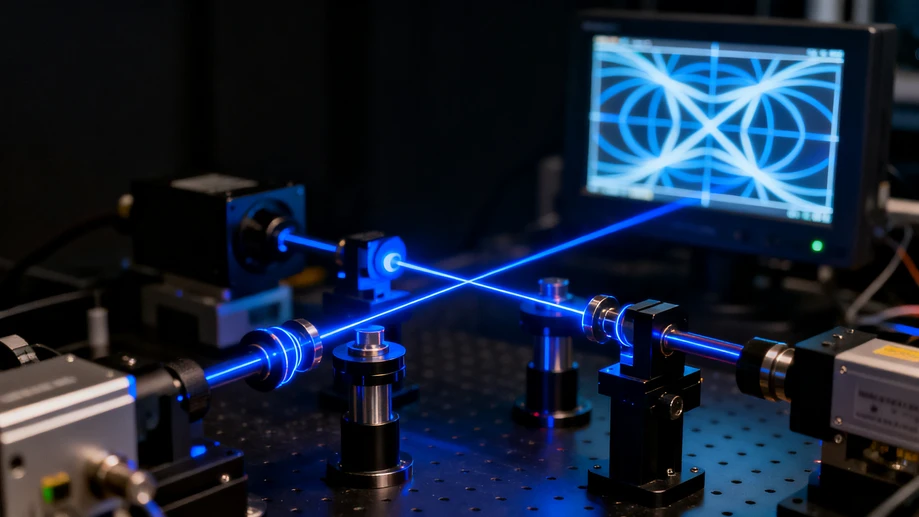
Experimental verification began with the 1972 Freedman-Clauser experiment testing Bell's theorem. By measuring polarization correlations between entangled photons, researchers demonstrated statistical violations impossible in classical physics. Modern experiments achieve entanglement over 1,200 kilometers using satellites, confirming the effect's persistence across cosmic scales. Laboratory setups now routinely entangle not just pairs but complex multi-particle systems, including macroscopic diamonds containing billions of entangled atoms. These advances consistently validate quantum mechanics' predictions while eliminating potential loopholes.
Quantum technologies harness entanglement as a fundamental resource. Quantum cryptography exploits entanglement to create theoretically unhackable communication channels. Any eavesdropping attempt disrupts the entangled state, alerting users immediately. Quantum computers utilize entangled qubits to perform parallel computations exponentially faster than classical systems for specific problems. Entanglement-enhanced sensors achieve unprecedented precision in measuring magnetic fields and gravitational waves, potentially revolutionizing medical imaging and fundamental physics research.
Ongoing research confronts entanglement's unresolved mysteries. Physicists investigate whether gravity plays a role in quantum decoherence—the process causing entangled systems to lose coherence in macroscopic environments. Experiments probe entanglement's thermodynamic properties and potential connections to spacetime geometry. The phenomenon's role in biological processes, such as photosynthesis, remains actively explored. Meanwhile, engineers develop methods to maintain entanglement in noisy environments, crucial for scaling quantum technologies. These investigations continuously reshape our understanding of information, causality, and the universe's fabric.