Quantum Entanglement: The Spooky Action at a Distance
How interconnected particles defy classical physics across vast cosmic distances
Quantum entanglement represents one of the most perplexing phenomena in modern physics, where two or more particles become inextricably linked such that the quantum state of each particle cannot be described independently. This connection persists instantaneously across any distance, whether millimeters or light-years, violating classical intuitions about locality and causality. When particles become entangled through interactions like photon emission or atomic decay, they exist in a shared quantum superposition where measuring one particle's property immediately determines the corresponding property of its partner, regardless of separation.
The mathematical foundation of entanglement stems from quantum mechanics' principle of superposition. Unlike classical bits existing as 0 or 1, quantum bits (qubits) can simultaneously embody multiple states. When qubits entangle, their wavefunctions merge into a single non-separable state described by the Schrödinger equation. This entanglement persists even when particles are physically separated, creating correlations that exceed classical limits. Experimental tests using Bell's inequality have conclusively demonstrated that entangled particles exhibit stronger statistical dependencies than any classical hidden variable theory could produce.
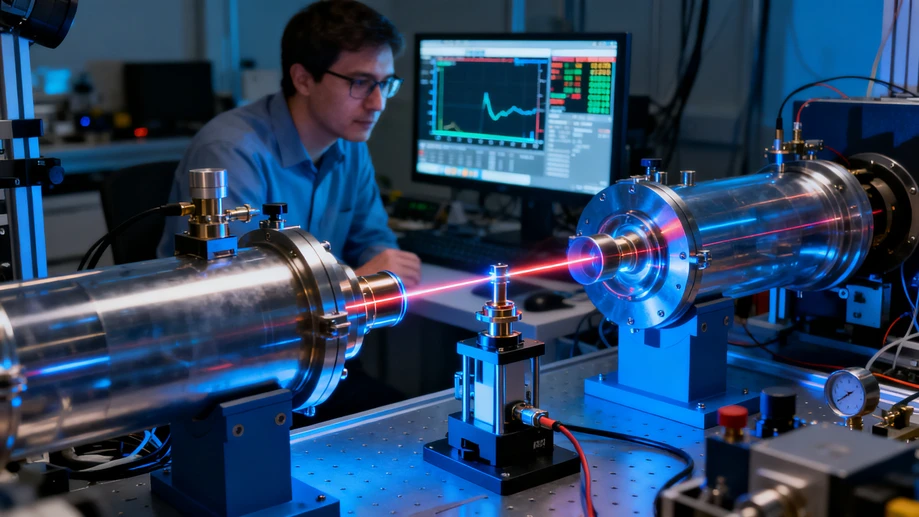
Experimental verification began with the pioneering work of Alain Aspect in 1982, whose photon polarization experiments confirmed entanglement's non-local nature. Modern laboratories now demonstrate entanglement across record distances using fiber optics and satellite links. The Micius satellite achieved entanglement distribution over 1,200 kilometers by beaming entangled photons to ground stations. These experiments employ sophisticated detectors to measure particle properties like spin, polarization, or momentum with nanosecond precision, eliminating potential loopholes through quantum randomness and measurement independence.
Entanglement enables revolutionary technologies unattainable through classical means. Quantum cryptography harnesses entanglement to create theoretically unhackable communication channels—any eavesdropping attempt disrupts the entangled state, immediately alerting users. Quantum computing exploits entangled qubits to perform parallel calculations through quantum parallelism, potentially solving problems intractable for classical supercomputers. Quantum teleportation protocols, demonstrated with photons and atoms, transfer quantum states between particles using entanglement as an information conduit without physical particle transfer.
The phenomenon raises profound questions about spacetime's fundamental nature. Einstein famously dismissed entanglement as "spooky action at a distance" because it seemingly violates relativity's cosmic speed limit. Current theories propose that entanglement doesn't transmit information faster than light but reveals pre-existing quantum correlations. Some physicists speculate that spacetime itself may emerge from a deeper quantum entanglement structure, as suggested by the ER=EPR conjecture linking entanglement with wormholes in general relativity. Ongoing research explores entanglement entropy to understand black hole information paradoxes and quantum gravity.
Entanglement degradation through decoherence remains the primary obstacle for practical applications. Environmental interactions rapidly disentangle particles, limiting quantum computer operation times. Laboratories combat this through electromagnetic trapping, cryogenic cooling near absolute zero, and topological quantum error correction. Future advancements aim to create robust multi-particle entanglement networks and hybrid quantum systems combining different physical platforms like superconducting circuits, trapped ions, and quantum dots for scalable quantum technologies.