Quantum Entanglement: The Invisible Thread Binding the Cosmos
When particles link states across space-time, redefining locality and reality.
Quantum entanglement describes a counterintuitive phenomenon where two or more particles become inseparably connected such that the quantum state of one instantly influences the other, regardless of distance. This connection persists even when particles are separated by light-years, violating classical intuitions about local interactions. The entangled particles exist in a single shared quantum state described by a wave function encompassing all participants. Measurements collapse this superposition into definite states, with correlations emerging that cannot be explained by pre-existing hidden variables.
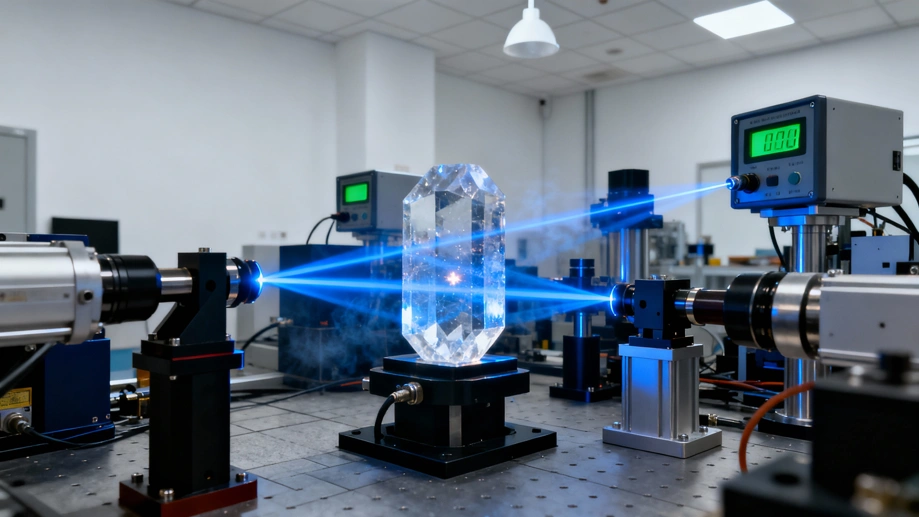
Experimental confirmation began with Bell's theorem in 1964, which mathematically disproved local hidden variable theories. Modern laboratories routinely demonstrate entanglement using photons, electrons, or atoms. In optical setups, photon pairs are generated through spontaneous parametric down-conversion. When detectors measure polarization of one photon, its entangled partner instantaneously adopts a correlated polarization state—verified through statistical violations of Bell inequalities. Space-based experiments like China's Micius satellite have maintained entanglement over 1,200 kilometers, testing quantum mechanics at cosmological scales.
The mechanism defies spacetime constraints through quantum nonlocality. Unlike information transfer via forces, entanglement requires no mediating particle or energy exchange. Relativity remains intact as no superluminal communication occurs: Random individual measurements yield no usable data, while statistical patterns reveal correlations only after classical comparison. Decoherence theory explains why macroscopic objects don't exhibit entanglement—environmental interactions destroy delicate quantum superpositions rapidly, highlighting the fine-tuned isolation needed for observation.
Practical applications harness this phenomenon. Quantum cryptography exploits entanglement for theoretically unhackable key distribution, as eavesdropping attempts disrupt correlations. Quantum teleportation transfers quantum states between locations using entangled pairs as channels, though no matter is transported. Quantum computers use entangled qubits to perform parallel computations via superposition. Entanglement-enhanced sensors achieve unprecedented precision in measuring magnetic fields or gravitational waves, surpassing classical detection limits.
Philosophically, entanglement challenges ontological assumptions about objective reality. The delayed-choice quantum eraser experiment suggests future measurements can retroactively influence past entanglement events. Some interpretations propose entanglement as evidence for emergent spacetime geometry, where locality derives from quantum connections. As research progresses into multi-particle entanglement and quantum networks, this "spooky action" continues to reshape our understanding of the universe's fundamental fabric.