What Is Quantum Entanglement and How Does It Challenge Our Understanding of Reality?
Exploring the counterintuitive phenomenon where particles remain mysteriously connected across vast distances
Quantum entanglement describes the extraordinary phenomenon where two or more particles become inseparably linked, sharing a single quantum state regardless of the physical distance separating them. When particles become entangled, measuring a property of one particle—such as its spin, polarization, or momentum—instantly determines the corresponding property of its partner, even if they're light-years apart. This instantaneous connection defies classical notions of locality and information transfer, operating outside the constraints imposed by the speed of light. Albert Einstein famously dismissed this as "spooky action at a distance," yet decades of rigorous experimentation have confirmed entanglement's validity, establishing it as a cornerstone of quantum mechanics.
The theoretical foundation for entanglement emerged from the 1935 Einstein-Podolsky-Rosen (EPR) paradox, which challenged quantum mechanics' completeness. Einstein argued that if quantum theory were correct, entangled particles would communicate faster than light—violating relativity. Niels Bohr countered that entanglement reflects quantum non-locality, where particles don't possess definite properties until measured. This debate remained philosophical until physicist John Bell proposed a mathematical framework in 1964 to test the phenomenon experimentally. Bell's inequality showed that if local hidden variables governed particle behavior, measurement correlations would have strict limits. When experiments violated this inequality—starting with Alain Aspect's 1982 photon tests—they conclusively demonstrated entanglement's non-local nature, proving quantum mechanics correct.
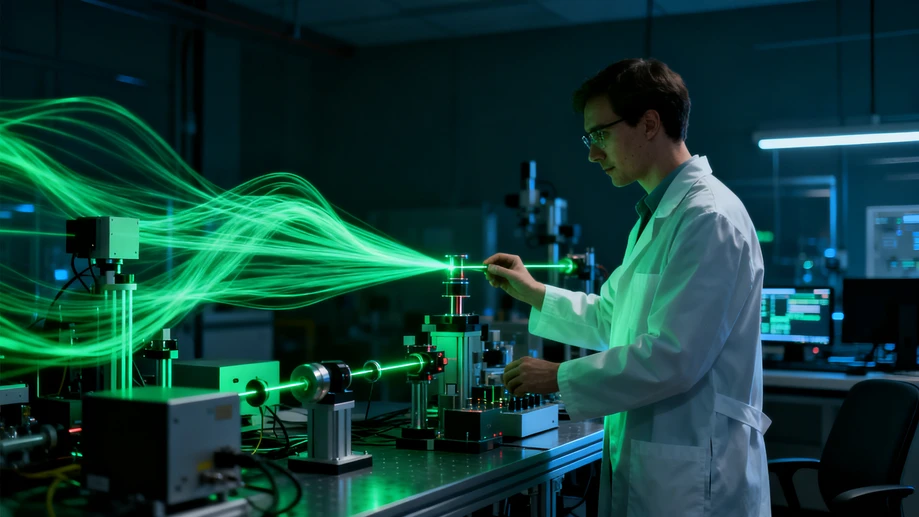
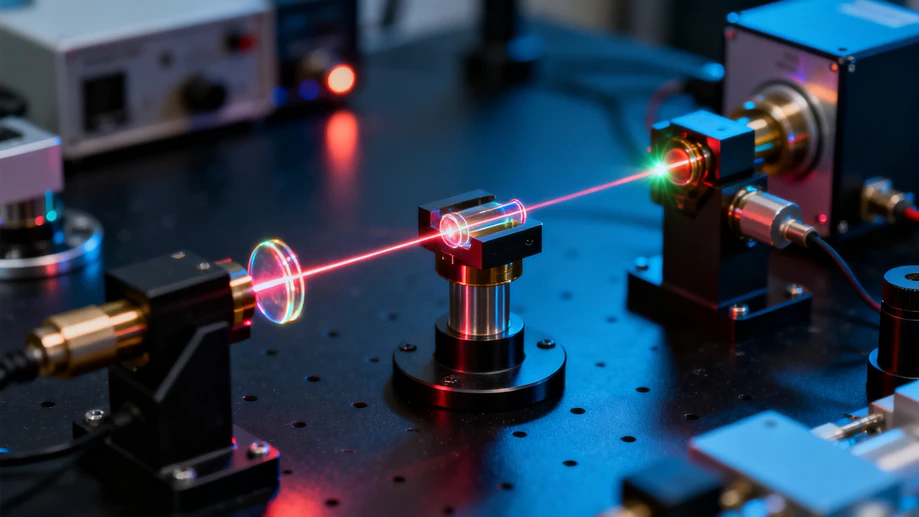
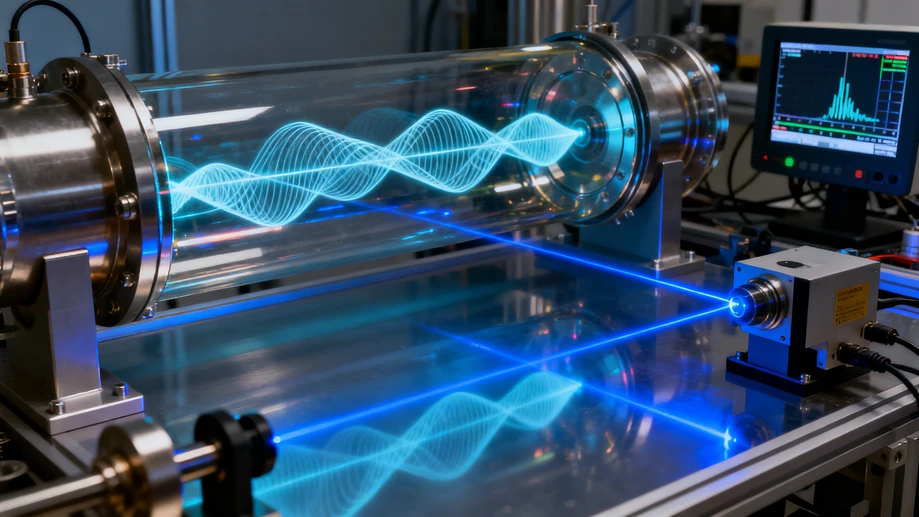
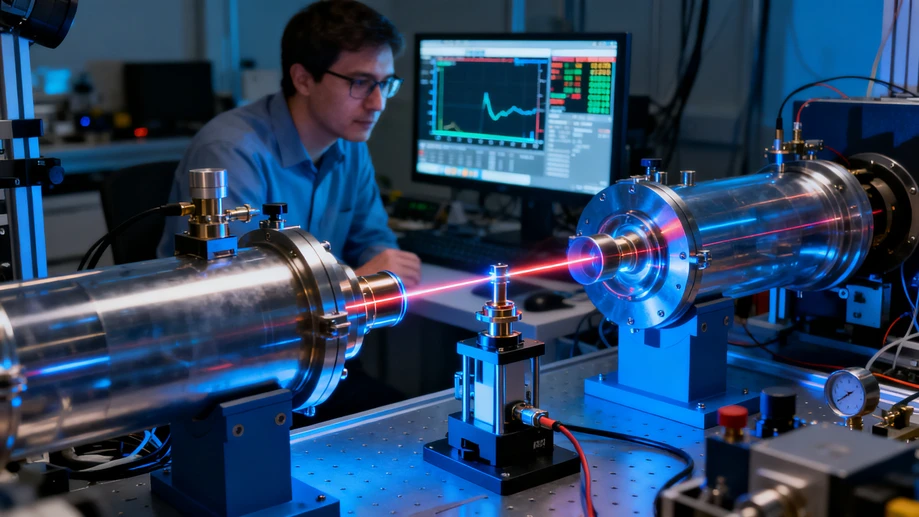
Entanglement manifests through precise experimental setups. Researchers create entangled particles using methods like spontaneous parametric down-conversion, where a laser beam passes through a crystal to generate pairs of photons with correlated polarizations. These particles are then sent to distant detectors. When one photon's polarization is measured, its entangled partner immediately adopts the complementary state. Remarkably, this correlation persists even when measurement choices are made randomly after the particles are separated, ruling out any pre-determined coordination. Recent experiments have maintained entanglement over 1,200 kilometers using satellites, confirming that neither environmental interference nor vast distances break the quantum bond.
Quantum entanglement underpins revolutionary technologies. Quantum cryptography exploits entanglement to create theoretically unhackable communication channels; any eavesdropping attempt disrupts the entangled state, alerting users instantly. Quantum computers leverage entangled qubits to perform parallel computations, solving problems intractable for classical systems. Entanglement-enhanced sensors achieve unprecedented precision in measuring magnetic fields and gravitational waves. These applications rely on maintaining coherence—the fragile quantum state vulnerable to environmental interactions. Researchers now focus on extending coherence times through error-correcting codes and isolating systems in ultra-cold, vacuum environments.
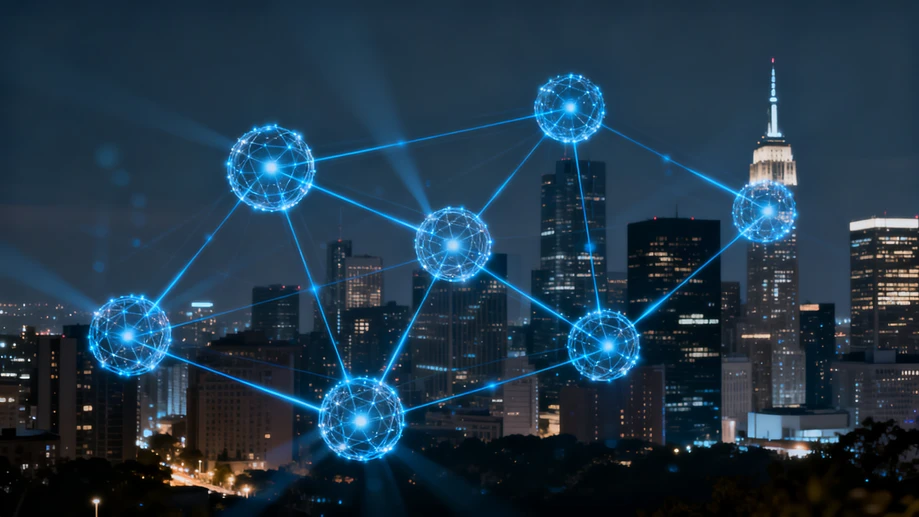
Entanglement challenges fundamental concepts of space and causality. It suggests the universe may be fundamentally non-local, with particles existing in a shared reality transcending spatial separation. Some interpretations propose that entangled particles aren't distinct entities but part of a unified quantum field. Others speculate entanglement might connect quantum mechanics with gravity through emergent spacetime theories. Despite its counterintuitive nature, entanglement follows strict probabilistic rules governed by the Schrödinger equation. Ongoing research explores multi-particle entanglement, quantum networks, and entanglement's role in biological processes like photosynthesis, continually expanding our understanding of this profound phenomenon.