Whispering Spinners: The Vertical Wind Revolution
How Silent, Low-Profile Turbines Are Reinventing Wind Power on Rooftops and Beyond
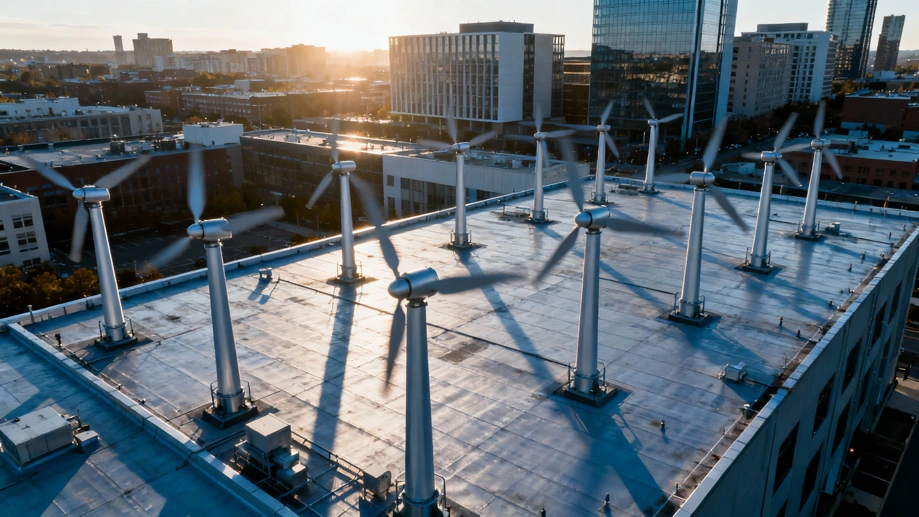
Imagine wind turbines not dominating vast landscapes, but quietly spinning above urban rooftops, tucked between buildings, or even integrated into skyscrapers themselves. Forget the giant, three-bladed giants you picture whirling in open fields. This is the world of Vertical Axis Wind Turbines (VAWTs), an unsung hero offering a unique twist on harvesting the breeze where traditional turbines simply can't operate. Unlike their horizontal-axis cousins (HAWTs), VAWTs spin around a vertical mast, resembling giant egg beaters, Savonius drums, or elegant helical spirals catching wind from any direction. This inherent design gives them a superpower perfectly suited for the messy, turbulent wind environments found in cities and densely built areas. While HAWTs need smooth, steady wind flowing head-on to work efficiently, VAWTs thrive on chaos.
But here’s where the vertical magic really kicks in. Think about the wind in a city. It swirls unpredictably down streets, ricochets off glass facades, and gets squeezed through narrow gaps. This chaotic "wind buffet" is terrible news for traditional HAWTs, which lose significant efficiency unless the wind hits their blades at a consistent angle. VAWTs, however, don't have to constantly pivot and reorient themselves like HAWTs do. Their blades interact with the wind equally well regardless of where it's coming from – north, south, east, west, or somewhere in between. This omnidirectionality means they can effectively capture energy from the constantly shifting gusts and eddies typical in urban canyons without needing complicated tracking systems. This simplicity translates directly into lower maintenance needs and potentially longer lifespans in harsh environments.
Place VAWTs together in an array, and another surprising phenomenon emerges: they can actually help each other perform better. With HAWTs, you must space them far apart to prevent the turbulent wake from one turbine dramatically reducing the efficiency of the one downstream. Researchers at Caltech made a fascinating discovery in 2011: strategically arranging VAWTs very close together can boost the total power output of the group significantly. When one turbine spins, it influences the air flow near its neighbors, essentially organizing the chaotic wind and potentially speeding it up for adjacent units. This counter-intuitive "packing density" advantage means VAWTs can generate more power per square meter of land (or rooftop) than equivalent HAWT arrays – like a school of fish moving efficiently together.
That ease of spinning also gives VAWTs another edge: a much lower cut-in speed. This is the minimum wind speed required for the turbine to start generating electricity. HAWTs typically need winds around 7-9 mph (4-5 m/s) just to begin turning and producing power. Many VAWTs, however, can start rotating and generating usable electricity with winds as gentle as 5-6 mph (2.5-3 m/s) or even less. This means they start producing power earlier and keep producing during lighter breezes that wouldn't register for larger turbines, effectively extending their operational window, especially useful in areas with generally lower average wind speeds.
Still, that’s not to say VAWTs are flawless. Physics dictates that a single, optimally designed HAWT will generally convert wind energy into electricity more efficiently than an equivalent VAWT under ideal, consistent wind conditions. VAWTs also often face higher material stresses on their lower bearings, requiring robust engineering. Yet, focusing solely on peak efficiency misses the crucial point: VAWTs unlock locations for wind power generation previously thought impractical or impossible. Their ability to operate productively in turbulent, gusty, multi-directional wind – precisely the kind found where people live and work – is what makes them a compelling game-changer.
Urban planners eye unused rooftop spaces on warehouses, factories, and even large residential buildings as prime real estate for small VAWTs. These installations could offset building energy consumption significantly. The tops of noise barriers lining highways could host VAWTs, turning corridors of traffic noise into clean energy corridors. Remote telecommunication towers could power themselves more reliably with VAWTs catching unpredictable mountain or desert winds. Even large off-grid homes and small communities are finding VAWTs an attractive option for distributed generation paired with solar panels. Their smaller size, relative quietness (especially helical designs with reduced blade tip noise), and vibration profile compared to similarly sized HAWTs make them far more neighbor-friendly.
Vertical Axis Wind Turbines remind us that the clean energy transition isn't a one-size-fits-all solution. While the horizontal giants will continue to dominate wind farms sweeping across plains and oceans, VAWTs offer a potent, complementary strategy. They bring wind power down to earth, into our cities and onto our structures. By exploiting niches traditional turbines ignore – chaotic wind patterns, tight spaces, low starting speeds, proximity demands – VAWTs are carving out a vital role. They turn wasted air currents dancing through our built environment into usable electricity, proving that sometimes, a different spin on an old idea is precisely what we need to harness the wind’s full potential right where we are. This quiet revolution in vertical design is spinning its way into the fabric of sustainable urban and distributed energy systems, one gust at a time.