What Is Quantum Entanglement?
A phenomenon where particles share states instantly across vast distances, defying classical intuition.
Quantum entanglement is a fundamental concept in quantum physics where two or more particles become intrinsically linked, so that the state of one instantaneously influences the other, no matter how far apart they are. This strange behavior, predicted by quantum mechanics in the early 20th century, emerges when particles like electrons or photons are created or interact in a way that their properties—such as spin or polarization—become correlated. For instance, if two entangled particles are separated by light-years, measuring the spin of one instantly determines the spin of the other without any physical signal passing between them. This non-local connection challenges the classical view of space and time, suggesting that the universe operates on principles where particles are not isolated entities but part of a deeper interconnected whole. Understanding entanglement requires grasping quantum superposition—where particles exist in multiple states simultaneously—and how entanglement forces a collapse to a definite state upon measurement.
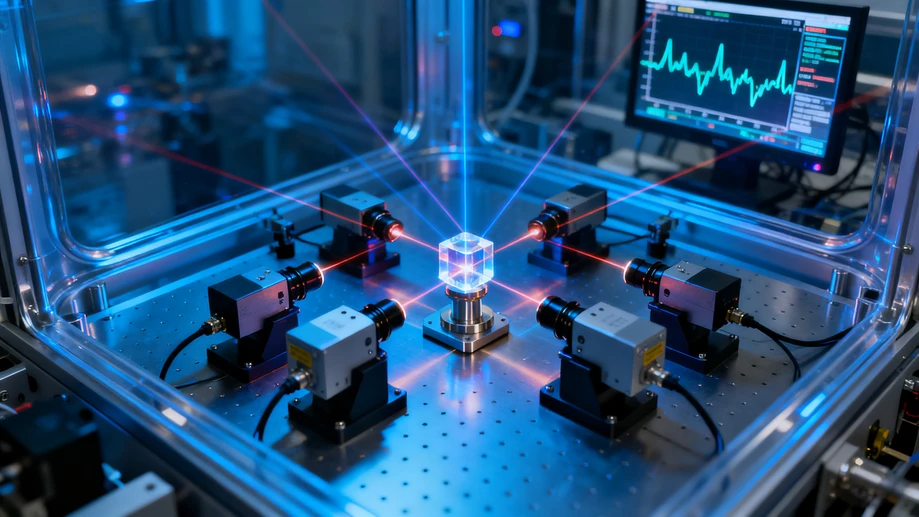
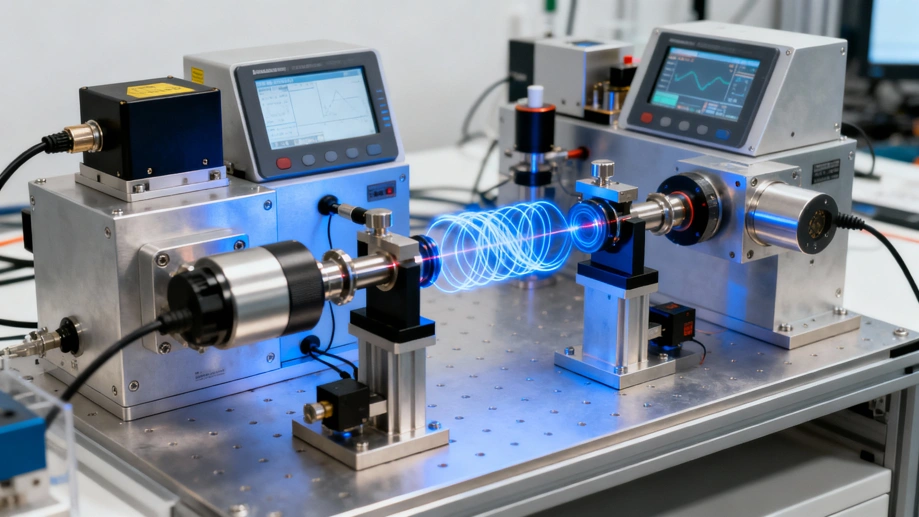
The concept gained prominence in the 1930s through the Einstein-Podolsky-Rosen (EPR) paradox, where Albert Einstein, Boris Podolsky, and Nathan Rosen argued that quantum mechanics must be incomplete because entanglement implied "spooky action at a distance" that violated the speed of light. They proposed that hidden variables—undetected properties—might explain the phenomenon more intuitively. However, in the 1960s, physicist John Bell developed Bell's theorem, which proved that no local hidden variables could account for entanglement's instant correlations. This set the stage for experimental validation: researchers like Alain Aspect conducted tests in the 1980s using entangled photons. Their measurements consistently showed correlations exceeding classical limits, confirming entanglement's reality. For example, Aspect's experiments used polarizers to detect photon alignments; when entangled photons were measured at different angles, the correlation rates matched quantum predictions precisely, discrediting Einstein's objections and reinforcing quantum theory's counterintuitive nature.
At its core, entanglement arises from quantum mechanics principles such as wave function entanglement. When particles interact—through processes like particle decay or photon emission—their wave functions become intertwined, creating a joint quantum state that must be described collectively rather than individually. This interdependence means that any measurement on one particle instantly collapses the shared wave function, determining the other's state. Paradoxes abound, such as how entanglement appears to transmit information faster than light, which might seem to break Einstein's theory of relativity. Yet, it adheres to causality because no usable data can be sent faster than light—entanglement correlations are random and cannot be controlled to transmit messages. Modern interpretations, like quantum decoherence, explain how environmental interactions can destroy entanglement over time, leading to probabilistic outcomes that align with our everyday macro-world experiences.
Real-world applications leverage entanglement for revolutionary technologies like quantum computing and cryptography. In quantum computing, entangled qubits enable exponential processing power: by maintaining superposition and entanglement, algorithms like Shor's can factor large numbers rapidly, potentially cracking modern encryption. Companies such as IBM and Google have built prototypes with entangled qubits to solve problems infeasible for classical computers. Quantum cryptography, specifically quantum key distribution (QKD), uses entanglement to create ultra-secure communication: any eavesdropping attempt disrupts the entangled state, alerting users instantly and ensuring unbreakable keys. For instance, satellite-based QKD systems like China's Micius demonstrate entanglement over thousands of kilometers, facilitating secure global networks. Future advances aim to harness entanglement in quantum sensors for ultra-precise measurements in medical imaging or gravitational wave detection.
Ongoing research and challenges highlight entanglement's vast potential and limitations. Scientists are probing entanglement in larger systems, like Bose-Einstein condensates, to test quantum-to-classical transitions and improve scalability for tech applications. However, maintaining entanglement over time and distance faces hurdles from environmental noise and decoherence. Experiments on the International Space Station are extending tests to reduce Earth's interference, while quantum repeaters aim to preserve entanglement in long-distance networks. Beyond technology, entanglement's implications for quantum gravity theories could unify physics, but it requires breakthroughs in understanding quantum measurement and observer effects. As we advance, entanglement not only redefines scientific paradigms but also promises to drive innovations from secure communications to advanced materials, making it a cornerstone of 21st-century discovery.