What Is Quantum Entanglement and How Does It Challenge Our Understanding of Reality?
Quantum entanglement, where particles become interconnected across space, defies classical intuition and opens new frontiers in technology and fundamental physics.
Quantum entanglement represents one of the most perplexing phenomena in quantum mechanics. When two or more particles interact under specific conditions, their quantum states become inseparably linked. This connection persists even when the particles are separated by vast distances—across a laboratory, a continent, or even light-years of space. Measurements performed on one entangled particle instantaneously determine the state of its partner, a phenomenon Einstein famously termed "spooky action at a distance." This non-local correlation violates classical notions of causality and locality, suggesting that information or influence can transcend spatial separation in ways that challenge our everyday understanding of reality.
The mathematical framework describing entanglement emerges directly from the superposition principle of quantum states. When particles interact, their wavefunctions merge into a single quantum state encompassing all possible configurations. Upon separation, this shared wavefunction prevents individual particles from being described independently. Only through measurement does the system collapse into definite states, yet the outcomes remain perfectly correlated. Experimental verification via Bell's theorem in the 1970s confirmed that entangled particles exhibit stronger statistical correlations than any classical hidden-variable theory could produce. This decisive evidence transformed entanglement from a theoretical curiosity into an empirically validated cornerstone of quantum theory.
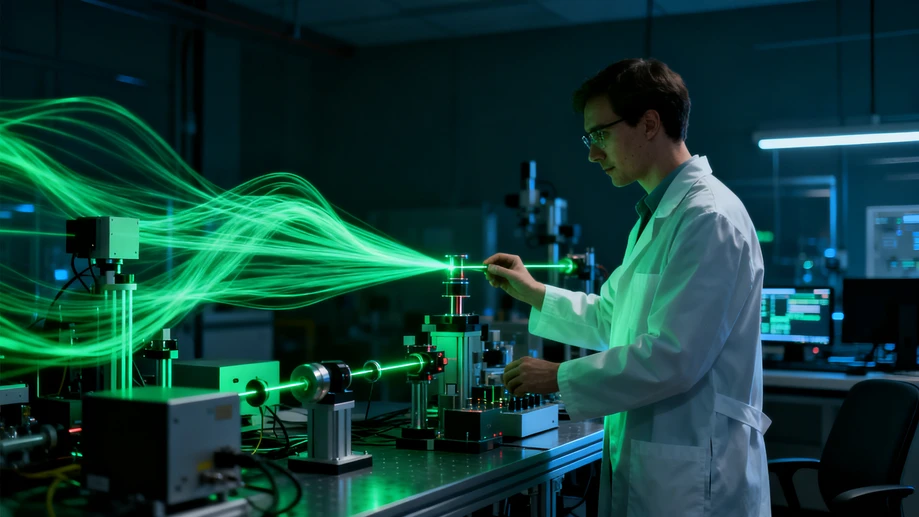
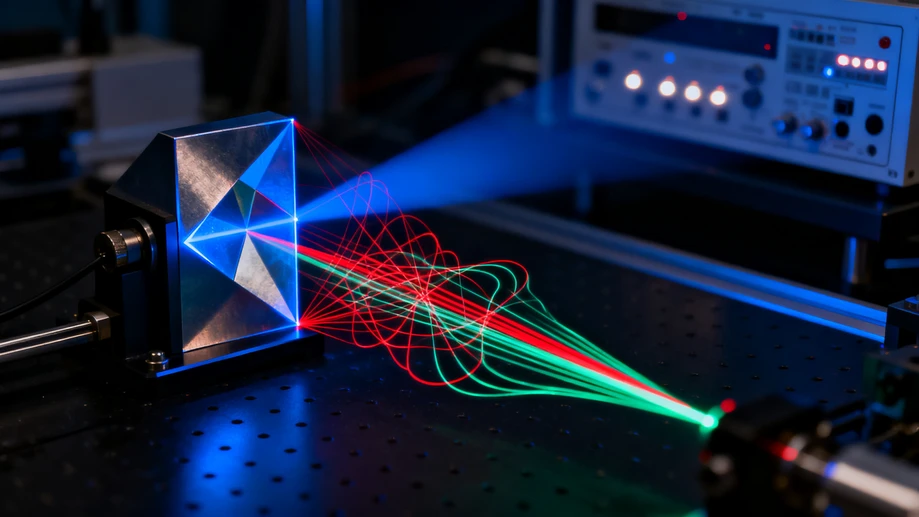
Entanglement manifests through measurable quantum properties such as spin polarization or photon polarization. In laboratory settings, entangled photon pairs are routinely created using spontaneous parametric down-conversion. When one photon passes through a polarizer and assumes a specific orientation, its entangled counterpart immediately adopts a complementary state regardless of detector distance. Crucially, this information transfer occurs faster than light speed, but no usable data can be transmitted, preserving causality. Advanced experiments have sustained entanglement over 1,200 kilometers via satellite-mediated photon exchange, demonstrating robustness at cosmic scales. These tests repeatedly confirm that quantum correlations persist where classical interactions would vanish.
Quantum entanglement fundamentally reshapes our comprehension of physical reality. It implies that the universe may not be composed of distinct, independently existing objects, but rather of deeply interconnected quantum systems. This challenges philosophical concepts of separability and objectivity, suggesting that observation actively participates in defining physical properties. The phenomenon also resolves measurement paradoxes in quantum mechanics by demonstrating that entangled states represent genuine physical connections rather than incomplete knowledge. These insights support interpretations where quantum events are relational rather than absolute, dependent on the context of interaction and measurement.
Technologically, entanglement drives revolutionary applications in secure communications and computing. Quantum key distribution exploits entangled photons to detect eavesdropping attempts, as any interception disrupts their delicate correlations. This enables theoretically unhackable encryption for financial and governmental networks. Quantum computers leverage entanglement to perform parallel calculations exponentially faster than classical systems for specific problems like molecular simulation or optimization algorithms. Emerging quantum sensors utilize entangled states to achieve unprecedented precision in measuring magnetic fields, gravitational waves, and timekeeping, potentially refining GPS accuracy to millimeter scales and enabling earlier detection of seismic events.
Ongoing research explores entanglement in increasingly complex systems. Physicists are investigating multi-particle entanglement, where networks of particles exhibit collective quantum behaviors. Experiments with macroscopic objects like diamonds and superconducting circuits demonstrate quantum coherence at larger scales, probing the boundary between quantum and classical domains. Theoretical work examines entanglement in gravitational frameworks, seeking connections between quantum mechanics and general relativity. These investigations may eventually reveal whether entanglement plays a role in spacetime structure itself. As experimental capabilities advance, testing entanglement’s role in photosynthesis and other biological processes may uncover quantum effects in life sciences.