Quantum Entanglement: The Invisible Thread Connecting Particles
How instantaneous correlations across vast distances challenge our understanding of physical reality
Quantum entanglement represents one of the most profound phenomena in modern physics, where two or more particles become inextricably linked regardless of separation. When particles become entangled, measuring a property of one particle—such as its spin, polarization, or momentum—instantly determines the corresponding property of its partner, even if separated by light-years. This connection defies classical intuition, operating faster than light-speed communication and challenging fundamental notions of locality and causality established since Einstein's relativity.
The mechanism originates during particle interactions where quantum states merge into a single wavefunction. When photons pass through certain crystals or electrons undergo specific interactions, their quantum properties become mathematically interdependent. This entanglement persists until measurement collapses the shared wavefunction. Remarkably, the particles exhibit perfect correlation without any detectable energy transfer or signal between them, a phenomenon Einstein famously dismissed as "spooky action at a distance" due to its apparent violation of local realism.
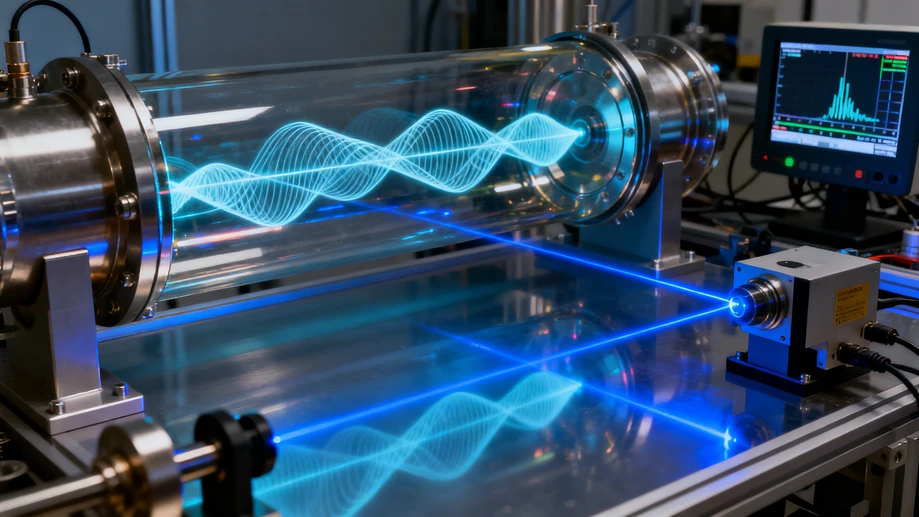
Experimental verification began in earnest following John Bell's 1964 theorem, which provided a mathematical framework to test entanglement against classical hidden variable theories. Seminal experiments by Alain Aspect in 1982 used polarized photons traveling through rapidly switching detectors to demonstrate violations of Bell inequalities. Subsequent experiments have confirmed entanglement across distances exceeding 1,200 kilometers using satellites, with measurement precision reaching 12 standard deviations—effectively ruling out local hidden variable explanations.
Quantum entanglement fundamentally reshapes information theory through quantum teleportation protocols. By sharing entangled particles as a resource, quantum states can be transferred between locations without physical particle movement. This enables quantum key distribution for theoretically unbreakable encryption, where any eavesdropping attempt disrupts the entangled state. The phenomenon also underpins quantum computing, where entangled qubits (quantum bits) process information in massively parallel states through superposition, offering exponential speedups for specific algorithms.
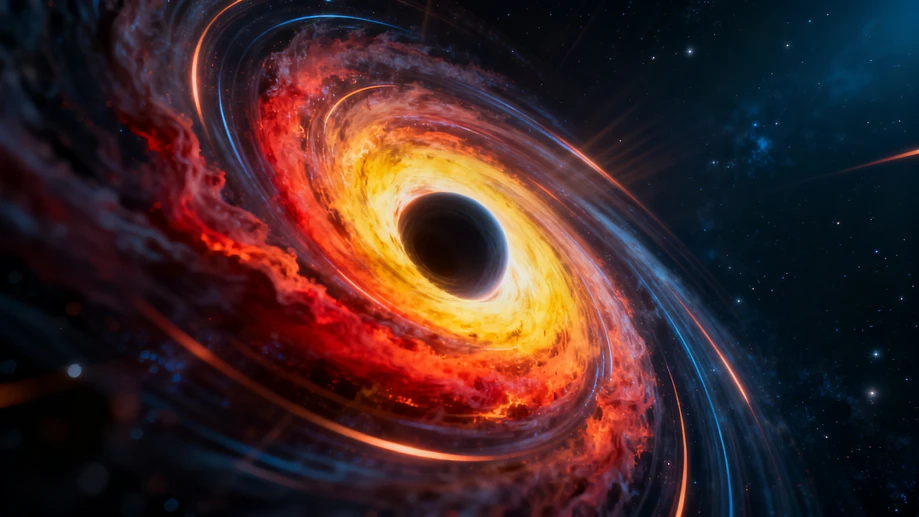
Ongoing research examines entanglement's role in quantum gravity and thermodynamics. Experiments probe whether entanglement can occur across time-like intervals, connecting particles that never coexisted. The ER=EPR conjecture suggests entangled particles might be connected by microscopic wormholes, potentially unifying quantum mechanics with general relativity. Meanwhile, studies of entanglement entropy explore how information becomes distributed across quantum systems, revealing deep connections to black hole physics and the holographic principle.
Despite technological applications, conceptual mysteries persist. The measurement problem—why wavefunction collapse occurs upon observation—remains unresolved. Decoherence theory explains how environmental interactions destroy entanglement, but not why individual measurements yield definite outcomes. Proposed interpretations range from the many-worlds hypothesis, where all possibilities manifest in parallel universes, to objective collapse models involving gravitational effects. Future experiments with massive entangled molecules may test these frameworks.
Practical implementations now extend beyond laboratory settings. Quantum networks using fiber-optic cables distribute entangled photons across cities, while satellite-based systems establish global quantum channels. These developments promise revolutionary advances in secure communications and sensor technology. Yet every technological breakthrough reinforces entanglement's most profound implication: that the universe operates not as a collection of discrete objects, but as an interconnected quantum web where spatial separation may be fundamentally illusory.