What Lies at the Heart of a Black Hole?
Exploring the enigmatic singularity and its cosmic implications through cutting-edge astrophysics.
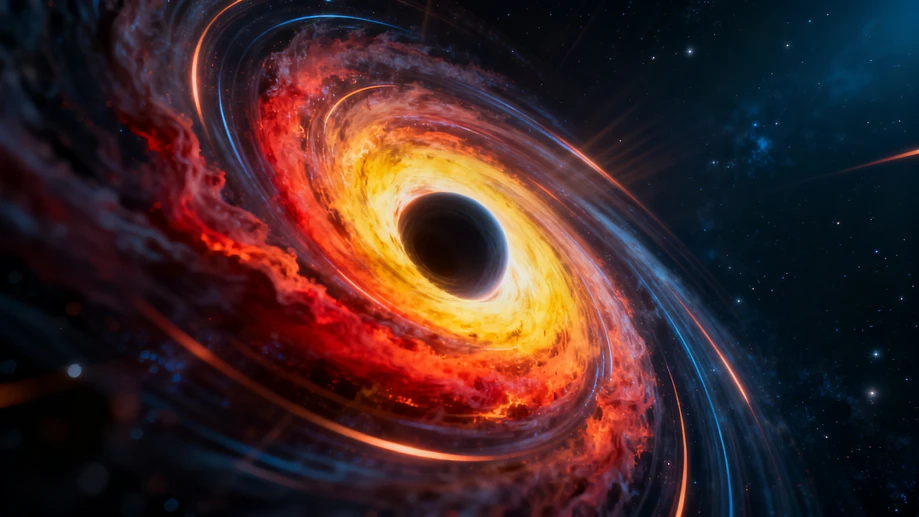
In the vast tapestry of the universe, black holes stand as profound mysteries, regions where gravity reigns supreme and light itself cannot escape. These cosmic behemoths form when massive stars exhaust their nuclear fuel, collapsing under their own gravitational pull into an infinitely dense point known as a singularity. The boundary of this phenomenon, the event horizon, marks the point of no return, beyond which even photons are irrevocably drawn inward. This extreme environment challenges our fundamental understanding of physics, merging the realms of general relativity and quantum mechanics in ways that continue to baffle scientists.
The birth of a stellar-mass black hole begins with a star at least 20 times the mass of our Sun. As fusion reactions cease in its core, outward pressure diminishes, allowing gravity to compress the star's remnants. If the core's mass exceeds the Tolman-Oppenheimer-Volkoff limit, it implodes into a singularity, often accompanied by a cataclysmic supernova explosion that scatters elements across space. This process not only seeds galaxies with heavy metals but also creates gravitational waves—ripples in spacetime first detected in 2015 by observatories like LIGO, confirming Einstein's century-old predictions.
At the heart of every black hole lies the singularity, a theoretical point of infinite density where spacetime curvature becomes extreme. Here, the laws of physics as we know them break down; general relativity suggests infinite gravitational forces, while quantum mechanics implies inherent uncertainties. This paradox highlights the need for a unified theory of quantum gravity. Surrounding the singularity, the event horizon's size scales with mass: a solar-mass black hole has a horizon radius of about 3 kilometers, whereas supermassive variants, like Sagittarius A* at our galaxy's center, span millions of kilometers, influencing galactic dynamics on a colossal scale.
Black holes are classified by mass, revealing diverse evolutionary paths. Stellar-mass black holes, ranging from 3 to 100 solar masses, pepper the Milky Way, formed from individual star deaths. Supermassive black holes, weighing millions to billions of solar masses, anchor galactic nuclei and grow through accretion—consuming gas and dust in swirling disks that emit intense X-rays detectable by telescopes. Intermediate-mass black holes, though rarer, may arise in dense star clusters, serving as missing links in cosmic hierarchies. Observations of stars orbiting invisible masses provide indirect evidence, while the Event Horizon Telescope's 2019 image of M87's shadow offered the first visual confirmation of a supermassive black hole's silhouette.
Quantum phenomena add layers of intrigue, particularly Hawking radiation. Proposed by Stephen Hawking in 1974, this theory posits that virtual particle pairs near the event horizon can lead to radiation emission, causing black holes to slowly lose mass and evaporate over astronomical timescales. For stellar-mass holes, this process spans billions of years, but it remains undetected experimentally, underscoring the interplay between thermodynamics and gravity. Additionally, relativistic jets—collimated streams of ionized matter—erupt from accretion disks, propelling material at near-light speeds and shaping interstellar environments.
Black holes play pivotal roles in cosmic evolution. They regulate star formation by heating galactic gas through feedback mechanisms, and their mergers generate gravitational waves that map the universe's structure. Future missions, such as advanced LIGO upgrades and space-based detectors like LISA, aim to probe primordial black holes from the Big Bang era, potentially revealing insights into dark matter and the early universe. As technology advances, these studies not only demystify black holes but also test the limits of human knowledge, pushing toward a grand unified theory that could redefine reality itself.