Quantum Entanglement: Cosmic Love Letters Written at Light Speed
How Particles Defy Space and Time With Instantaneous Bonding
Imagine two coins that always land opposite faces when flipped – heads and tails perfectly coordinated whether separated by inches or oceans. Now shrink this phenomenon to subatomic size, amplify its precision to cosmic scales, and you get quantum entanglement: nature's most intimate long-distance relationship.
At its core, entanglement means two particles become permanently linked, sharing a single quantum identity regardless of separation. When scientists measure a property like spin direction of one entangled particle, its partner instantly assumes the complementary state. This connection happens faster than light could travel between them, seeming to violate relativity's cosmic speed limit. Einstein famously dismissed this as "spooky action at a distance," yet countless experiments confirm entanglement's reality.
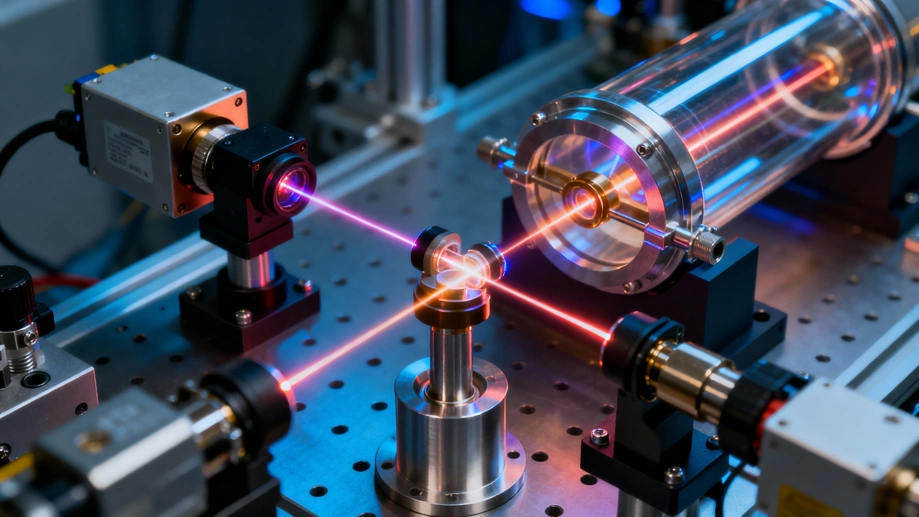
What makes entanglement extraordinary isn't just the speed, but the method behind it. Unlike conventional signals needing physical carriers like photons or electrons, entangled particles communicate through their shared quantum state. Consider it similar to flipping a single coin with two faces magically appearing in different locations – measuring one side instantly determines its counterpart's state across galaxies. Laboratories routinely entangle particles across kilometers using fiber optics where photons act as messenger carriers to establish the initial bond.
The magic deepens with quantum superposition – particles existing in multiple states simultaneously until measured. An electron spins both clockwise and counterclockwise until observed. In entangled pairs, measuring one particle collapses both into definite states at once. This creates correlations impossible in classical physics, like particles predicting each other's behavior without detectable signals. Recent experiments demonstrate entanglement across 1,200 kilometers using satellites, proving these bonds persist through Earth's atmosphere into space.
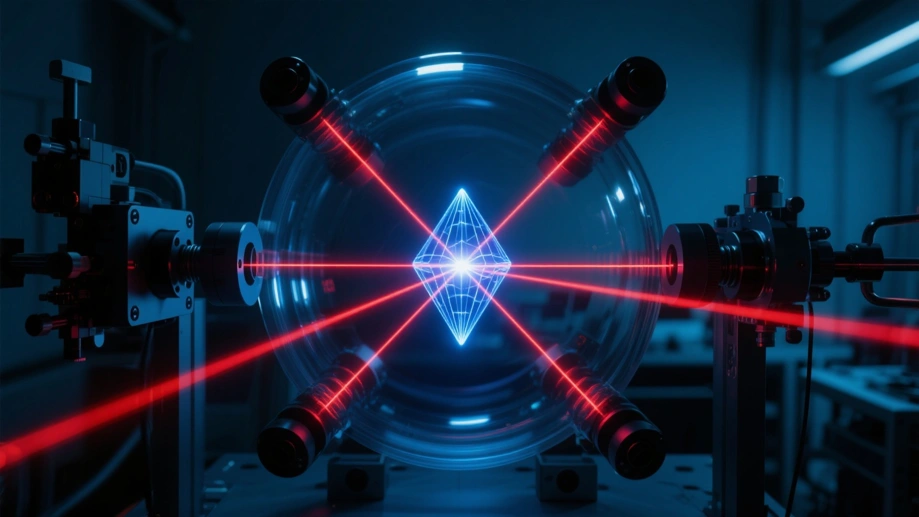
Surprisingly, entanglement doesn't require identical particles. Scientists entangle photons with electrons, atoms with molecules, even microscopic diamonds with billions of atoms. This opens possibilities for hybrid quantum systems where different particle types contribute unique advantages. A photon might carry quantum information efficiently over long distances while a trapped electron securely stores it at the destination.
Practical applications emerge from this phenomenon beyond theoretical puzzles. Quantum cryptography relies on entanglement for unhackable communication. Any eavesdropper attempting to intercept quantum keys inevitably disturbs the entanglement bond, immediately alerting users to security breaches. Pharmaceutical companies use quantum computers leveraging entanglement to simulate molecular interactions for drug discovery, enabling calculations far exceeding classical computers' capabilities.
The future may hold quantum radar detecting stealth objects by their quantum signatures. Early prototypes already outperform conventional systems through entanglement-enhanced sensitivity. Researchers envision quantum networks acting like sensitive planetary-scale nervous systems for detecting gravitational waves or earthquakes with unprecedented precision by connecting monitoring stations through entangled photons.
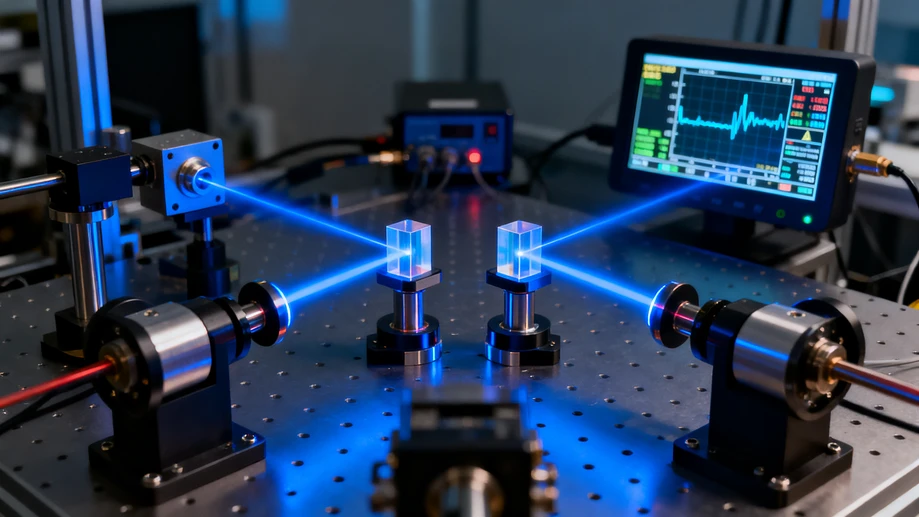
Observing entanglement required overcoming significant hurdles. Quantum states remain fragile, easily disrupted by environmental noise like electromagnetic interference or temperature fluctuations. Scientists combat this through ultra-pure materials like specialized crystals for generating photon pairs, cryogenic cooling near absolute zero to minimize vibrations, and sophisticated quantum error correction techniques maintaining coherence.
Experiments continuously push entanglement's limits. Recent breakthroughs include entangling thousands of atoms simultaneously and maintaining quantum links for hours instead of microseconds. Other teams successfully entangle microscopic mechanical resonators – silicon beams vibrating in perfect quantum unison even when physically separated. This mechanical entanglement could link quantum devices to existing fiber-optic networks.
Entanglement challenges conventional understanding of space and connectivity. Its persistent mystery makes it endlessly fascinating: the universe has built-in connections transcending spatial distances and faster than any signal we've conceived. As research advances, we discover that even the smallest particles maintain inexplicable bonds that could reshape technology and our fundamental view of reality.