Could Your Next Meal Be Designed by a Computer?
How Algorithms Are Secretly Optimizing the Food on Your Plate
Imagine biting into a strawberry that tastes like childhood summers but stays plump for weeks, or savoring cheese made without a single cow. This isn't science fiction—it's your grocery store's emerging reality. Biotechnology now threads through our daily diets with invisible precision, moving far beyond Frankenfood fears into a realm of tailored nutrition and sustainable abundance. Computational biology platforms analyze millions of genetic sequences to predict plant traits, while AI designs proteins found nowhere in nature. From Tokyo to Texas, this quiet revolution transforms how we grow, process, and experience food—one optimized enzyme and data-driven crop at a time.
Consider the humble soybean. Machine learning models now scan its DNA like code, identifying segments that boost drought resistance or protein content. Farmers in Brazil plant gene-edited varieties thriving in arid soils that once lay barren, while North American labs engineer oils that eliminate trans fats without compromising flaky pie crusts. CRISPR technology enables these subtle tweaks—snip, adjust, replicate—without introducing foreign genes. The result? Crops with built-in climate resilience that require fewer pesticides, quietly challenging industrial agriculture’s chemical dependency. Every non-browning mushroom or virus-resistant papaya carries a digital fingerprint of calculated biological upgrades.
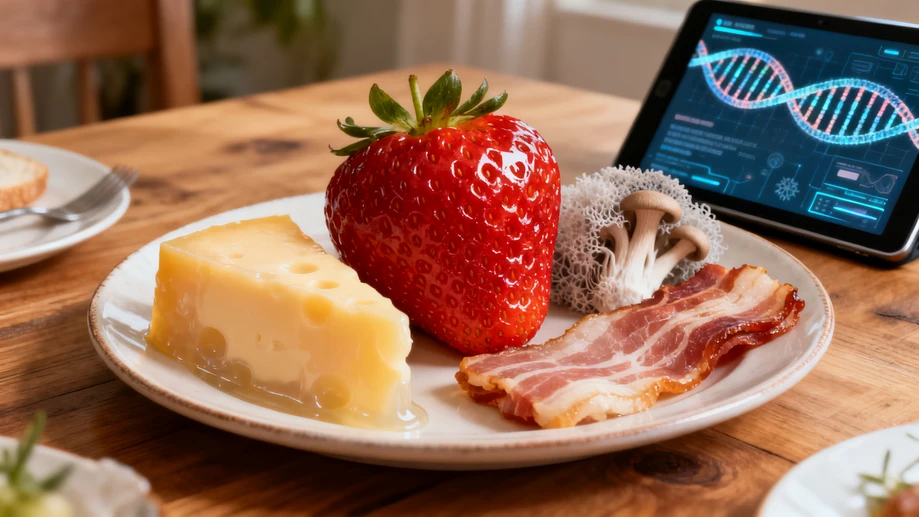
Protein production underwent its own seismic shift. Precision fermentation tanks now house microbes programmed to churn out dairy-identical casein or egg-white proteins, bypassing livestock entirely. Companies like Perfect Day use yeast as microscopic factories, producing lactose-free ice cream indistinguishable from traditional scoops. Meanwhile, mycelium—fungus roots—grows into bacon alternatives in days rather than months, absorbing flavors like culinary sponges. These innovations slash land and water use by up to 90%, offering carnivores guilt-free indulgence. Your burger might soon feature "blended" tech: plant-based patties laced with cultivated fat cells for that irreplaceable juicy sizzle.
Even flavor itself is getting a biotech makeover. Algorithms map chemical compounds responsible for umami richness or floral notes, then guide engineered yeast to replicate them sustainably. Vanilla, often harvested by underpaid farmers, now materializes in bioreactors from modified bacteria—identical to the bean but without deforestation. Breweries employ enzyme cocktails to accelerate aging, transforming harsh spirits into smooth bourbon in hours instead of years. Such advances democratize luxury ingredients while shrinking supply chains. That aromatic saffron in your paella? It might originate from a petri dish rather than a Persian field.
Yet challenges persist like stubborn weeds. Regulatory hurdles vary wildly; Singapore fast-tracks cultured meat while Europe demands extensive GMO labeling. Consumer skepticism lingers despite rigorous safety validations—a "bioengineered" label can deter shoppers more effectively than any scientific paper reassures them. And while startups promise allergen-free peanuts or caffeine-enhanced coffee beans, ethical debates simmer about patenting life’s building blocks. The path forward demands transparency: open-source genetic databases and chef collaborations demystifying tech-driven foods. After all, biotechnology’s greatest triumph won’t be a super-crop, but widespread trust in the unseen architects of our meals.