Quantum Entanglement: The Spooky Connection at a Distance
How particles instantaneously influence each other across cosmic distances defies classical physics
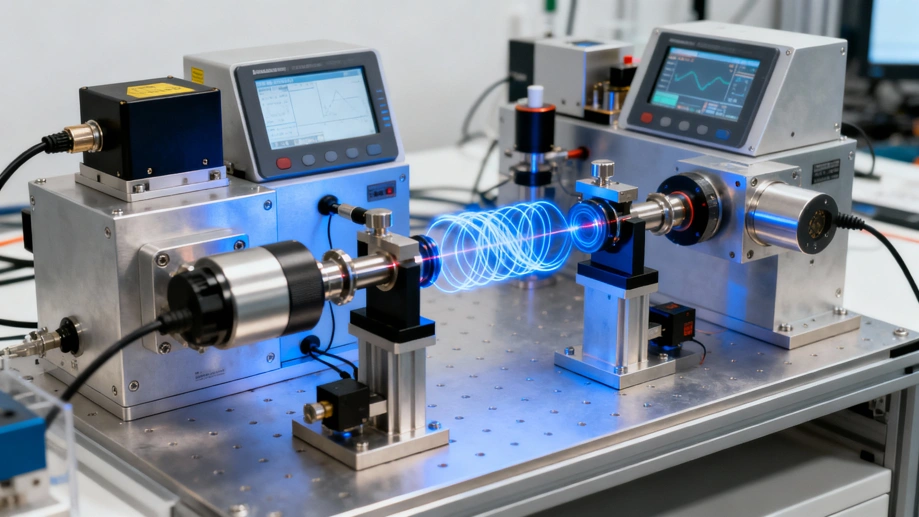
When two quantum particles become entangled, they form a connection so profound that measuring the state of one instantly determines the state of the other, regardless of the distance separating them. This phenomenon, which Einstein famously called "spooky action at a distance," occurs even when particles are light-years apart. Entanglement represents a fundamental departure from classical physics, where information cannot travel faster than light. The entangled particles behave as a single quantum system rather than independent entities, with their properties remaining correlated in ways that defy intuitive understanding.
Quantum entanglement emerges when particles interact or are created together, causing their quantum states to become interdependent. For example, when an electron-positron pair is produced from energy, their spins must be opposite due to conservation laws. Once entangled, measuring the spin of the electron immediately reveals the spin of the positron—even if it's on the opposite side of the galaxy. This instantaneous correlation occurs without any detectable signal or energy transfer between the particles, challenging the principle of locality that underpins classical mechanics.
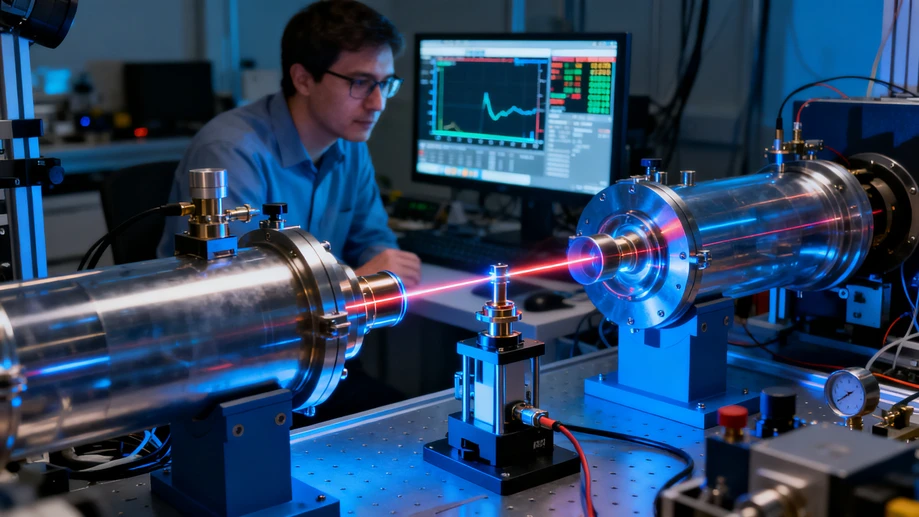
Experimental verification began with John Bell's 1964 theorem, which provided a testable distinction between quantum mechanics and local hidden variable theories. The landmark Aspect experiments in the 1980s used polarized photons separated by 12 meters, demonstrating violation of Bell's inequalities. Subsequent experiments extended this to distances exceeding 1,200 kilometers using satellites and fiber optics. These tests consistently confirm that entangled particles maintain correlations that cannot be explained by any classical mechanism, establishing entanglement as a non-local quantum reality.
The mathematics of entanglement involves quantum superposition and wavefunction collapse. Before measurement, entangled particles exist in a superposition of all possible states. The wavefunction describing the system encompasses both particles simultaneously. Measurement causes this shared wavefunction to collapse instantaneously, determining both particles' states. This collapse occurs faster than light could travel between them, yet crucially, it cannot transmit information faster than light—a subtlety preserving Einstein's relativity while revolutionizing quantum theory.
Quantum technologies harness entanglement for revolutionary applications. Quantum cryptography exploits entanglement to create unbreakable encryption keys—any eavesdropping attempt disrupts the entanglement, alerting communicators. Quantum computers use entangled qubits to perform parallel computations exponentially faster than classical computers for specific problems. Quantum teleportation protocols transfer quantum states between distant locations using entangled pairs as quantum channels, though this transports information rather than matter itself.
Despite its experimental confirmation, entanglement poses profound questions about quantum foundations. The measurement problem—why wavefunction collapse occurs upon observation—remains unresolved. Some interpretations propose decoherence through environmental interaction, while others suggest multiple parallel universes. Recent research explores entanglement in macroscopic systems, including diamonds and superconducting circuits, testing quantum behavior at larger scales. These investigations probe the quantum-classical boundary and may illuminate gravity's role in quantum mechanics.
Entanglement reveals a universe deeply interconnected at the quantum level, where space itself may emerge from quantum networks. As research advances from quantum sensors to quantum networks, entanglement promises to transform both our understanding of physical reality and technological capabilities. This "spooky" connection continues to challenge our notions of space, time, and information, proving that the quantum world operates by rules far stranger than classical intuition could ever predict.