Quantum Entanglement: The Invisible Thread Connecting Particles Across Space
How linked particles defy classical physics through instantaneous correlation
At the subatomic scale, particles exhibit behaviors that challenge fundamental notions of reality. Quantum entanglement describes a phenomenon where two or more particles become inseparably linked, sharing a single quantum state regardless of distance. When particles become entangled, measurements performed on one immediately determine the properties of its partner, even when separated by light-years. This instantaneous connection operates outside the constraints of light-speed communication, forming the cornerstone of quantum mechanics that troubled Einstein, who famously called it "spooky action at a distance."
The entanglement process begins when particles interact through collisions or energy exchanges. Their quantum states—such as spin, polarization, or momentum—become mathematically interdependent. This interdependence creates a unified wave function describing the entire system. Crucially, entangled particles don't possess definite individual properties until measurement occurs. The act of measuring one particle collapses the shared wave function, instantly fixing the state of its entangled counterpart. This non-local correlation violates classical intuition, where objects require physical signals to influence each other.
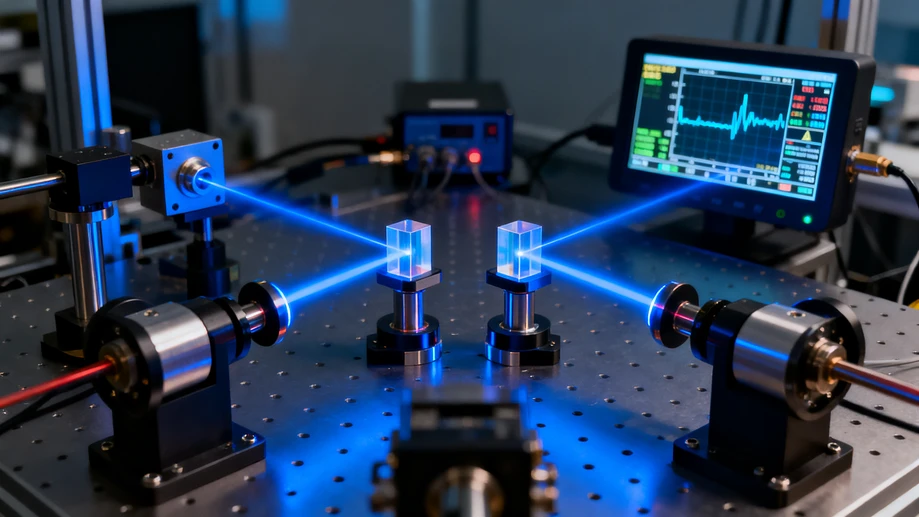
Experimental verification emerged through Bell's theorem tests in the 1970s. Scientists directed entangled photons toward polarization filters at distant detectors. Statistical analysis revealed correlations exceeding classical limits, confirming entanglement's non-local nature. Modern laboratories routinely generate entangled particles using spontaneous parametric down-conversion crystals. When pumped by lasers, these crystals split photons into entangled pairs with opposite polarizations. Such experiments consistently demonstrate violation of Bell inequalities by factors exceeding 30 standard deviations, eliminating doubts about quantum non-locality.
Quantum entanglement enables revolutionary technologies. Quantum cryptography exploits entanglement to create theoretically unbreakable encryption keys. Any eavesdropping attempt disrupts the delicate quantum state, alerting communicators immediately. Quantum computing utilizes entangled qubits to perform parallel calculations through superposition. This allows quantum processors like Google's Sycamore to solve specific problems exponentially faster than classical supercomputers. Future quantum networks may employ entangled photons as information carriers across satellite relays, establishing ultra-secure global communication infrastructures immune to conventional hacking.
Despite its counterintuitive nature, entanglement operates within quantum field theory's framework. The phenomenon doesn't transmit information faster than light, preserving causality. Instead, it reveals quantum systems' inherent wholeness—where spatially separated components remain aspects of a single quantum entity. Ongoing research explores entanglement's role in quantum gravity and black hole thermodynamics. Recent experiments successfully entangled macroscopic objects like 20-micrometer diamonds, bridging quantum phenomena with the classical world and opening pathways for quantum-enhanced sensors.
Understanding entanglement reshapes our conception of spacetime's fabric. Rather than passive emptiness, the vacuum exhibits quantum fluctuations where particle-antiparticle pairs spontaneously entangle and annihilate. This quantum foam structure suggests entanglement may underpin spacetime geometry itself. As laboratories achieve entanglement over 1,200-kilometer distances via satellite links, the phenomenon transitions from theoretical curiosity to technological bedrock—promising to revolutionize computation, communication, and our fundamental understanding of physical reality.