The Phenomenon of Quantum Entanglement
A Deep Dive into the Intricate Connection Between Distant Particles, Redefining Reality
Quantum entanglement, a cornerstone of quantum mechanics, describes a phenomenon where two or more particles become inextricably linked, such that the state of one instantly influences the state of another, regardless of the distance separating them. This connection persists even if the particles are light-years apart, challenging classical notions of locality and causality. Particles involved can be electrons, photons, or other quantum entities, with their properties—like spin or polarization—correlating in a way that defies intuitive explanation. The effect arises during particle interactions, such as decay or collisions, and leads to a shared quantum state where measurements on one particle dictate outcomes for the other instantaneously. This instantaneous correlation violates Einstein's principle that nothing can travel faster than light, sparking intense debates and highlighting the non-local nature of quantum reality. It underscores a fundamental aspect of the universe where interconnectedness transcends physical separation, forming the bedrock for advanced quantum technologies.
The theoretical foundations emerged early in quantum theory development, with key equations predicting entanglement as a direct consequence of superposition and wave function collapse. Schrödinger's equation, for instance, models how particles can exist in multiple states simultaneously, and when entangled, their wave functions remain intertwined. This entanglement is preserved until measurement occurs, causing a collapse to a definite state in both particles simultaneously. Experiments confirmed this in the 20th century, with Bell's theorem providing a mathematical framework to test locality. Violations of Bell's inequalities in lab settings showed that quantum correlations could not be explained by hidden variables or pre-existing properties, proving entanglement is a genuine quantum effect. Such findings revolutionized physics by demonstrating that reality at the quantum level operates beyond classical constraints, emphasizing probabilistic outcomes over deterministic predictions and fueling innovations in quantum information theory.
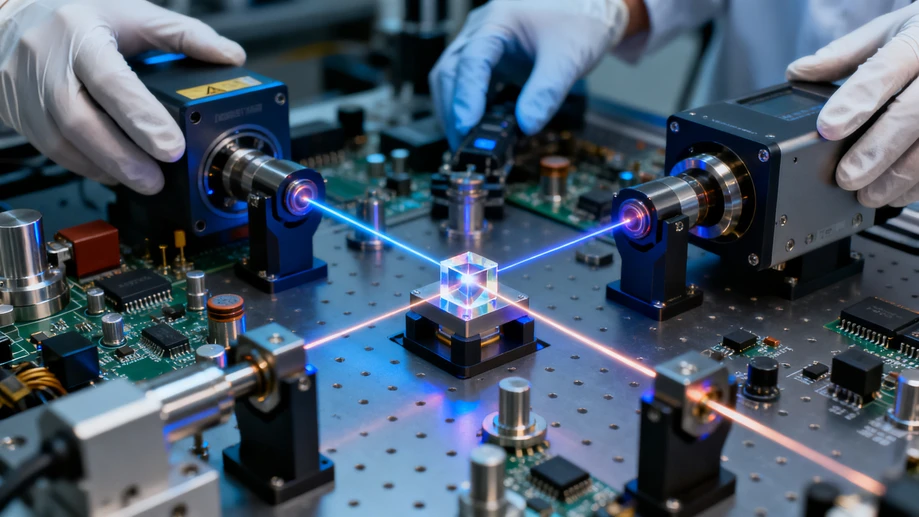
Experimental verification relies on sophisticated setups, such as photon pairs generated through spontaneous parametric down-conversion, where entangled photons are emitted and sent to distant detectors. When one photon's polarization is measured, the other's polarization instantly matches, as seen in tests across vast distances, including satellite-based experiments spanning hundreds of kilometers. Recent advancements use trapped ions or superconducting qubits in controlled environments to observe entanglement with high precision. Technological instruments like interferometers and quantum detectors measure correlations with statistical significance, often exceeding 90% fidelity. These experiments consistently show faster-than-light correlations without energy transfer, resolving initial skepticism and providing empirical evidence for quantum mechanics. The repeatability across labs worldwide underscores entanglement as a robust phenomenon, paving the way for practical applications in secure communication and computing by leveraging these inherent quantum links.
Practical applications harness entanglement's unique properties to transform modern technology. In quantum cryptography, entanglement enables ultra-secure communication protocols like quantum key distribution, where any eavesdropping attempt disrupts the entangled state, making transmissions inherently hack-proof. For instance, QKD systems are now deployed in government and financial networks to protect sensitive data. Quantum computing leverages entangled qubits to perform parallel computations, solving complex problems exponentially faster than classical computers, such as simulating molecular structures for drug discovery or optimizing logistics. Emerging fields include quantum teleportation, where information is transmitted via entangled pairs without physical movement, and quantum sensors for high-precision measurements in fields like navigation. These innovations demonstrate how entanglement moves from abstract theory to real-world tools, offering solutions to current limitations in encryption, data processing, and material science.
Future research focuses on extending entanglement to larger scales and new domains, such as macroscopic objects or biological systems, to probe quantum gravity and fundamental constants. Ethical implications arise regarding secure data and AI integration, necessitating global frameworks. Yet, challenges persist in maintaining entanglement over long distances due to environmental decoherence, driving innovations in quantum repeaters to amplify signals. The continued exploration of entanglement promises breakthroughs in unifying quantum theory with relativity, potentially revealing deeper layers of reality where space and time emerge from quantum connections.