Quantum Entanglement: The Spooky Connection That Defies Distance
A fundamental quantum phenomenon where particles remain intrinsically linked regardless of separation.
At the subatomic scale, particles can form relationships that transcend classical physics. When two quantum particles become entangled, their properties become interdependent in ways that defy conventional understanding. Measuring the state of one particle instantaneously determines the state of its partner, even if separated by cosmic distances. This connection remains unbroken until measurement occurs, creating correlations stronger than any classical system could achieve. The phenomenon emerges naturally from quantum superposition principles, where particles exist in multiple states simultaneously until observed.
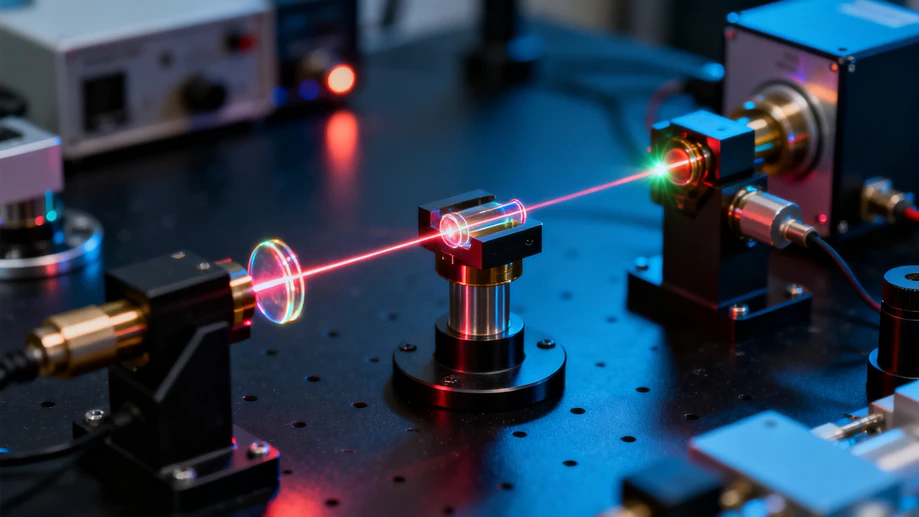
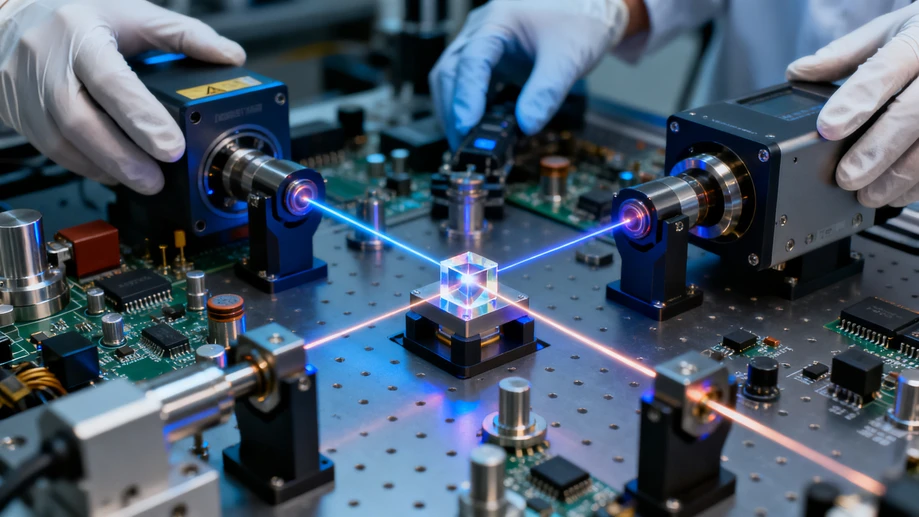
Experimental verification began with John Bell's 1964 theorem, which provided a mathematical framework to distinguish quantum entanglement from hidden variable theories. Landmark experiments by Alain Aspect in the 1980s used polarized photons traveling in opposite directions to demonstrate violation of Bell's inequalities. When detectors measured photon polarization at angles set after the particles' emission, results showed correlations exceeding classical limits by over 30 standard deviations. Subsequent experiments using entangled particles separated by over 1,200 kilometers continue to confirm this non-local behavior, with information transfer occurring faster than light could traverse the distance.
The mechanism operates through shared quantum states described by wavefunction collapse. Consider two electrons created simultaneously with opposite spins. While unmeasured, both spins exist in superposition. When one electron's spin is measured as "up," the other's wavefunction instantly collapses to "down," regardless of physical separation. This doesn't involve faster-than-light communication but reflects a fundamental quantum reality where the particles don't possess definite properties until measured. Entanglement can involve multiple properties including position, momentum, polarization, and even time-evolution states.
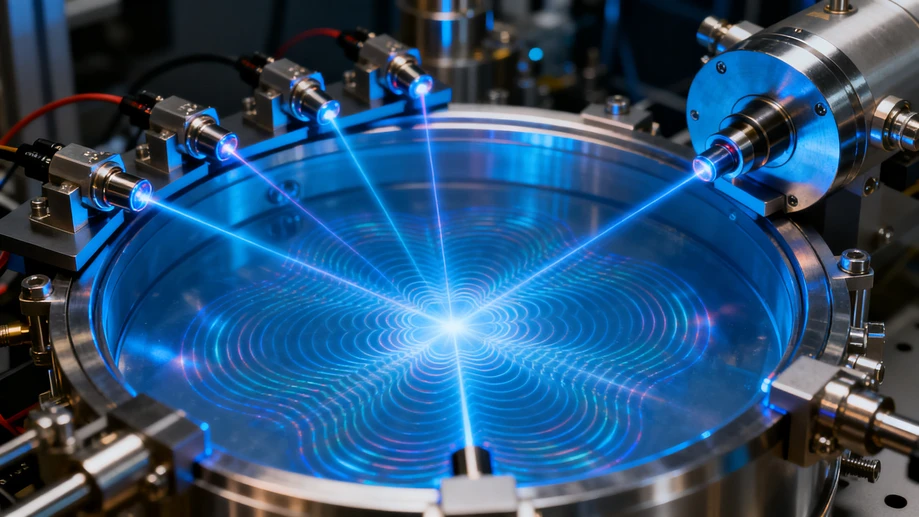
Practical applications are revolutionizing technology. Quantum cryptography exploits entanglement to create theoretically unhackable communication channels—any eavesdropping attempt disrupts the entangled state, alerting users. Quantum computers use entangled qubits to perform parallel computations impossible for classical systems. Recent experiments demonstrate quantum teleportation, transferring quantum states between particles using entanglement as the transmission medium. Emerging quantum networks aim to connect these technologies across global distances using satellite-based entanglement distribution.
Ongoing research explores entanglement in increasingly complex systems. Scientists now entangle macroscopic objects like diamonds containing trillions of atoms, probing quantum-classical boundaries. Experiments with quantum memories store entangled states for minutes, enabling delayed-choice measurements. The phenomenon's role in quantum gravity theories suggests space-time itself may emerge from entangled quantum information. As detection methods advance using superconducting circuits and trapped ions, entanglement continues to challenge our understanding of reality while enabling unprecedented technological capabilities.