What Causes the Ethereal Dance of the Northern and Southern Lights?
Decoding the Electromagnetic Phenomenon Behind Earth's Celestial Light Displays
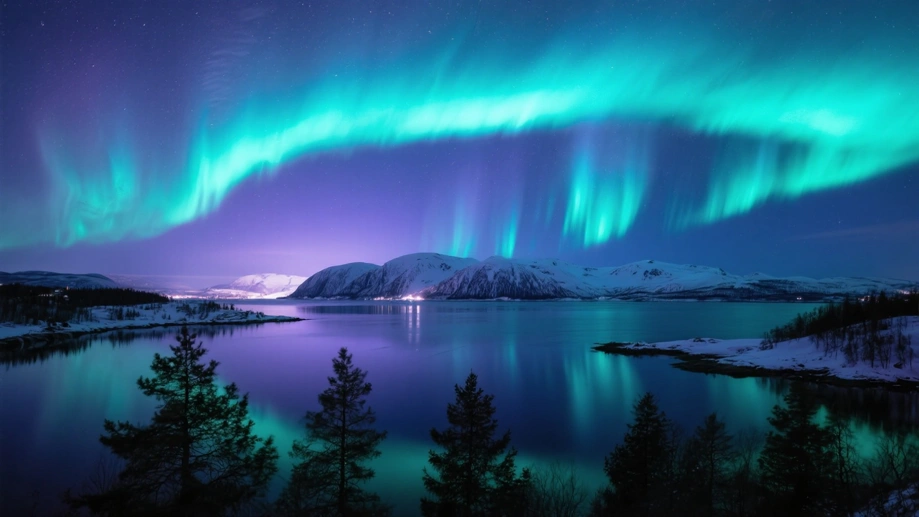
Auroras, the mesmerizing curtains of colored light that ripple across polar skies, represent one of the most visually stunning interactions between our planet and the Sun. These luminous phenomena occur when charged particles from solar winds collide with Earth's magnetosphere. Accelerated along magnetic field lines toward the poles, these particles excite atmospheric gases approximately 100-400 kilometers above the Earth's surface. The ensuing energy release manifests as photons of distinct wavelengths, painting the heavens with ethereal hues ranging from electric greens to deep crimsons and vibrant violets. The precise colors depend on atmospheric composition: oxygen emissions produce green (557.7 nm) and red (630 nm) light, while nitrogen contributes blues and purples.
The journey of these solar particles begins with coronal mass ejections (CMEs), where the Sun violently expels billions of tons of plasma threaded with magnetic fields. Traveling at speeds up to 8 million km/h, this magnetized solar wind approaches Earth within 15 minutes to several days. Our planet's magnetosphere – the invisible magnetic field extending thousands of kilometers into space – serves as both shield and conduit. While deflecting most solar particles, its geometry funnels charged particles into "cusps" near the poles, creating concentrated zones known as auroral ovals where activity peaks.
At the quantum level, auroral photons emerge through energy transfer processes involving nitrogen and oxygen molecules. When solar electrons collide with oxygen atoms, they excite electrons to higher energy states. As these electrons return to ground state after milliseconds or seconds, they emit characteristic photons. Molecular nitrogen produces violet and blue emissions through shorter-lived excitations. Altitude plays a crucial role: green auroras dominate at 100-240 km where atomic oxygen concentration peaks, while nitrogen-based reds appear below 100 km and oxygen-based reds above 240 km.
Auroras exhibit remarkable structural diversity shaped by solar wind intensity and magnetospheric currents. During geomagnetic storms, they manifest as shimmering curtains that shift dramatically from "quiet arcs" to dynamic "rayed bands" that may move poleward at 10 km/s. The phenomenon extends globally; while known as Aurora Borealis in the north and Aurora Australis in the south, both hemispheres experience near-symmetric displays thanks to the magnetosphere's dipolar nature. Satellites capture simultaneous conjugate auroras that mirror each other across hemispheres despite differing terrain below.
Space weather forecasting now provides auroral predictions through sophisticated models analyzing solar imagery, solar wind data, and magnetospheric indices. Unexpected consequences emerge from extreme events – intense electromagnetic fluctuations during geomagnetic storms induce currents that can disrupt power grids exceeding 10 GW capacity, while orbital radiation surges degrade satellite electronics and navigation systems. Understanding auroras extends beyond aesthetics: they offer real-time diagnostics of solar-terrestrial interactions that impact technological civilization.
Contemporary research employs cutting-edge methodologies, including incoherent scatter radar mapping ionospheric electron densities and specialized rockets sampling charged particles mid-aurora. Modern all-sky cameras documented a previously undiscovered auroral form in 2018: thin purple streaks dubbed "STEVEs" (Strong Thermal Emission Velocity Enhancement) unrelated to traditional particle precipitation. As humanity eyes crewed missions beyond Earth's protective magnetosphere, comprehending the forces creating these ghostly lights becomes vital for predicting space radiation hazards throughout the solar system.