Quantum Entanglement: The Invisible Thread Rewriting Physics
When particles mysteriously synchronize across vast distances, they reveal fundamental truths about our universe.
Quantum entanglement remains one of physics' most profound phenomena, wherein two or more particles become inseparably linked such that the quantum state of one instantly influences the other—regardless of distance. This non-local connection defies classical intuition about information transfer speed. Albert Einstein famously dismissed it as "spooky action at a distance," reflecting early skepticism towards its counterintuitive nature. Theoretical groundwork by Schrödinger and others established that entangled particles exist in a shared quantum superposition until measurement collapses their states. Experiments with photons or electrons separated by kilometers confirm synchronization occurs faster than light could travel between them.
John Bell's 1964 theorem provided a mathematical framework to test entanglement's legitimacy against hidden variable theories. His inequalities established that if quantum mechanics holds, certain statistical correlations between entangled particles must exceed classical limits. Alain Aspect's 1982 experiments violated Bell’s inequalities decisively, demonstrating that entangled photons exhibit polarization correlations impossible under local realism. Subsequent research validated entanglement over 1,200-kilometer distances using satellite-based quantum keys. These tests confirm that measurement of one entangled photon’s spin axis immediately determines its partner’s axis—even if altered mid-flight—effectively eliminating any hidden information carrier.
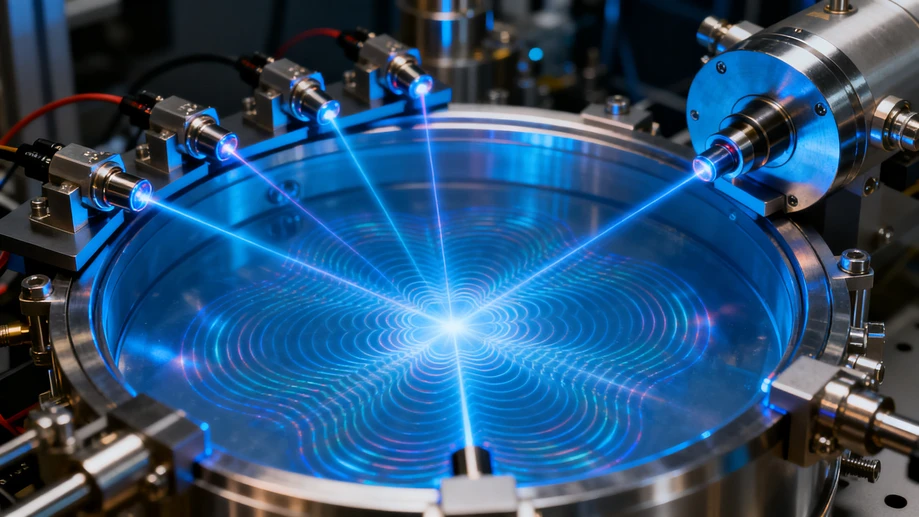
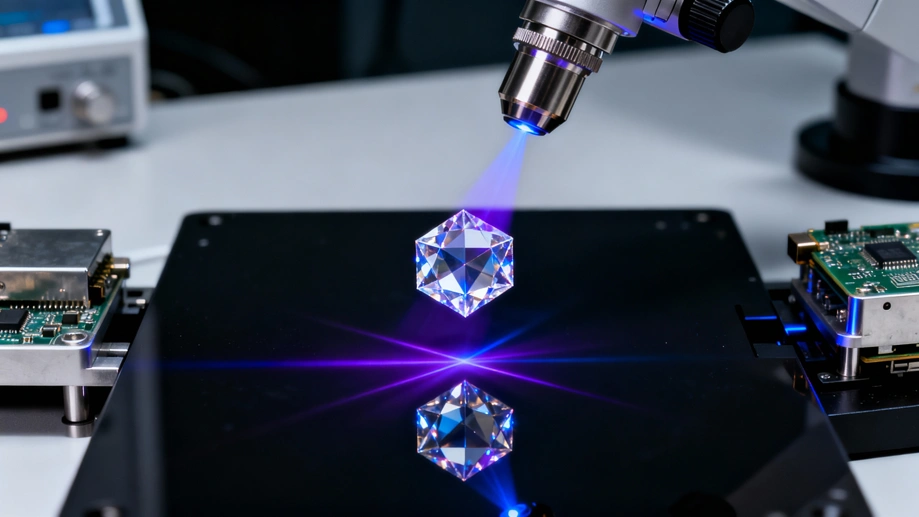
Modern laboratories manipulate entanglement using nonlinear crystals that split photons into entangled pairs through spontaneous parametric down-conversion. Superconducting circuits and trapped ions maintain entanglement coherence by minimizing environmental decoherence. Quantum teleportation exploits entanglement to transfer quantum states between particles without physical travel. A sender measures an entangled pair and a target particle, transmitting classical data enabling the receiver to reconstruct the target's quantum information on their own entangled partner. While not matter transportation, it demonstrates entanglement-enabled information transfer protocols impossible through classical channels.
Entanglement drives revolutionary technologies: Quantum cryptography leverages it for theoretically unbreakable encryption through quantum key distribution. Any interception attempt disrupts entangled states, alerting communicators. Quantum computers employ entangled qubits to perform parallel computations exponentially faster than classical systems for specific tasks like factoring large numbers. Quantum sensors using entangled atoms achieve unprecedented precision in measuring magnetic fields or gravitational waves. Ongoing research explores biological entanglement implications and gravitational effects on quantum coherence. However, scaling practical systems demands sustained entanglement durations challenging to maintain against ubiquitous environmental interactions that cause quantum decoherence.