The Science Behind Tornado Formation: Unraveling Atmospheric Chaos
An expert examination of the meteorological processes that spawn destructive tornadoes, covering their development, characteristics, and societal impacts.
Tornadoes are rapidly rotating columns of air that extend from the base of a thunderstorm cloud to the ground, capable of inflicting catastrophic damage with wind speeds exceeding 300 miles per hour. These phenomena represent one of Earth's most violent weather events, occurring primarily in specific geographic regions due to atmospheric instability. Scientifically classified as vortices, tornadoes form when warm, moist air collides with cool, dry air, creating a horizontal spin that is tilted vertically by intense updrafts. This process is catalyzed by severe thunderstorms, often in supercell systems, where wind shear and convective energy build rotational momentum within a mesocyclone. Understanding the genesis of tornadoes is crucial for meteorologists and communities in high-risk zones, as it enables improved prediction models and risk mitigation strategies.
The formation of tornadoes initiates under specific synoptic conditions, including the presence of a strong temperature gradient at the surface and upper atmosphere. Typically, this involves a clash between warm, humid air masses from tropical regions and cold, dry air descending from polar fronts. For instance, in the central United States, such clashes create an ideal breeding ground, known as "Tornado Alley." As solar radiation heats the surface, warm air rises explosively, forming cumulonimbus clouds with powerful updrafts. Simultaneously, directional wind shear—where wind speed and direction change with altitude—induces horizontal rotation. When this rotation is vertically tilted by updrafts within the storm, it concentrates into a narrow, rotating funnel cloud. If it touches down, it becomes a tornado, with a lifecycle ranging from seconds to over an hour, depending on environmental sustenance.
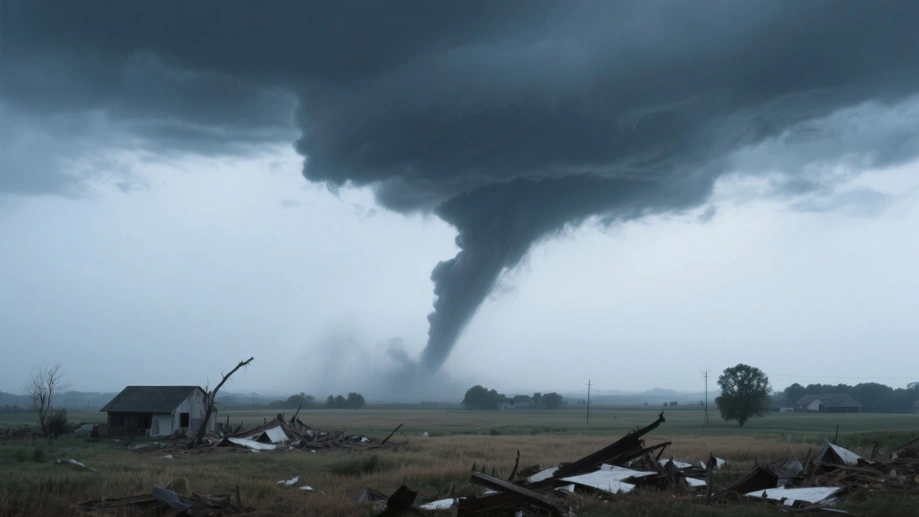
Structural characteristics of tornadoes include their distinctive funnel shape, which can vary from rope-like to wedge-like formations. The core vortex generates immense centrifugal forces, reducing pressure at the center and allowing debris to be lofted skyward. Wind speeds within the vortex are measured using the Enhanced Fujita (EF) Scale, ranging from EF0 (65-85 mph) to EF5 (>200 mph), based on observed damage. Advanced instruments like Doppler radar and mobile weather stations capture real-time data, revealing that tornado diameters typically span 50-500 yards, while paths stretch for miles. Their intensity is fueled by moisture influx and unstable lapse rates, where temperature drops rapidly with height. Remarkably, radar studies show that most tornadoes rotate counterclockwise in the Northern Hemisphere, a consequence of Coriolis effects from Earth's rotation.
Geographically, tornado distribution is highly heterogeneous, with hotspots concentrated in mid-latitude regions like the Great Plains of the US, eastern India, Bangladesh, and parts of Argentina. These areas share common traits: flat terrain facilitating unobstructed storm development and proximity to moisture sources like oceans. Statistics indicate that the US experiences over 1,200 tornadoes annually, accounting for more than 75% of global occurrences, primarily during spring and summer. Other regions, such as Europe and Australia, report fewer events due to weaker atmospheric contrasts. This pattern stems from global wind patterns and jet stream influences, which steer storm systems toward convergence zones. Climate change research suggests potential shifts, with models indicating increased frequency in traditionally low-risk areas due to warming oceans altering atmospheric stability.
Historical tornado events underscore their devastating potential, such as the 2011 Joplin, Missouri, EF5 tornado, which claimed 161 lives and caused $2.8 billion in damage. This event highlighted gaps in early warning systems despite advanced detection technology. Analysis of past tornadoes reveals key lessons: rapid intensification can occur in minutes, and debris fields often extend far beyond the core path. In 1925, the Tri-State Tornado traversed 219 miles across multiple states, a record for longevity, emphasizing how environmental persistence prolongs devastation. Modern case studies, like the Moore, Oklahoma tornado in 2013, integrate ground surveys and satellite imagery to refine damage assessment, showing correlations between urban density and casualty rates due to flying debris and structural collapse.
Tornado prediction relies on sophisticated meteorological tools, such as dual-polarization radar, which detects rotation signatures within storms by analyzing precipitation particles. Numerical weather models run by organizations like the National Weather Service simulate atmospheric conditions hours in advance, identifying areas with high convective available potential energy (CAPE) and storm relative helicity (SRH). When indices exceed thresholds, tornado watches are issued, followed by warnings if rotation is imminent. In recent years, AI-driven algorithms have enhanced lead times to 15-20 minutes by correlating radar data with historical events. Despite advances, false alarms remain a challenge, requiring community education on shelter protocols. Innovations like tornado sirens and mobile alerts aim to reduce response time, but public drills and building codes are vital for preparedness.
Protective measures against tornadoes emphasize proactive strategies, including structural reinforcements and evacuation drills. The safest locations are underground shelters or interior rooms on the lowest floor, away from windows. Post-2011 standards have improved building codes in high-risk areas, mandating reinforced concrete and wind-resistant materials. Societal approaches involve government programs like FEMA's Tornado Preparedness Initiative, which funds early warning networks and community training. Research shows that timely interventions can cut fatalities by over 50%, underscoring the role of interdisciplinary science. Future directions include developing multi-hazard warning systems that integrate tornado alerts with flood and fire risks, alongside public-private partnerships for disaster resilience.
In conclusion, tornadoes epitomize the delicate balance of atmospheric dynamics, with their formation rooted in intricate interactions among wind, temperature, and humidity. As global climates evolve, ongoing research into predictive models and mitigation strategies remains essential for safeguarding communities. Emerging technologies, such as drone-based monitoring and climate adaptation frameworks, promise to enhance understanding and reduce risks, making tornado science a critical field for planetary resilience.