What is Quantum Entanglement and How Does it Challenge Our Understanding of Reality?
Quantum entanglement is a fundamental phenomenon in quantum mechanics where particles become inseparably linked, defying classical physics and prompting deep questions about the nature of existence.
Quantum entanglement represents one of the most perplexing aspects of modern physics, emerging from the principles of quantum mechanics. At its core, it describes a state where two or more particles become interconnected in such a way that the properties of one particle instantaneously influence those of another, regardless of the distance separating them. This interconnection occurs when particles are created or interact in a manner that their quantum states—such as spin, polarization, or momentum—become correlated. For instance, if two entangled photons are generated from a single source, measuring the spin of one photon will immediately determine the spin of the other, even if they are light-years apart. This phenomenon violates the classical notion that information cannot travel faster than light, as no physical signal is exchanged; instead, the correlation is inherent in the quantum state itself.
The discovery of entanglement traces back to early 20th-century debates among physicists, notably highlighted by Albert Einstein, who famously referred to it as "spukhafte Fernwirkung" or "spooky action at a distance." Einstein, along with colleagues Podolsky and Rosen, proposed the EPR paradox in 1935 to argue that quantum mechanics must be incomplete because entanglement suggested non-local interactions that contradicted relativity. They posited that if quantum theory were correct, it would imply faster-than-light communication, which they deemed impossible. This paradox set the stage for decades of theoretical and experimental work. In the 1960s, physicist John Bell developed Bell's theorem, a mathematical framework that distinguished between local hidden variable theories (which Einstein favored) and quantum mechanics. Bell's inequalities showed that if experiments violated these inequalities, quantum entanglement must be real and non-local, providing a testable prediction.
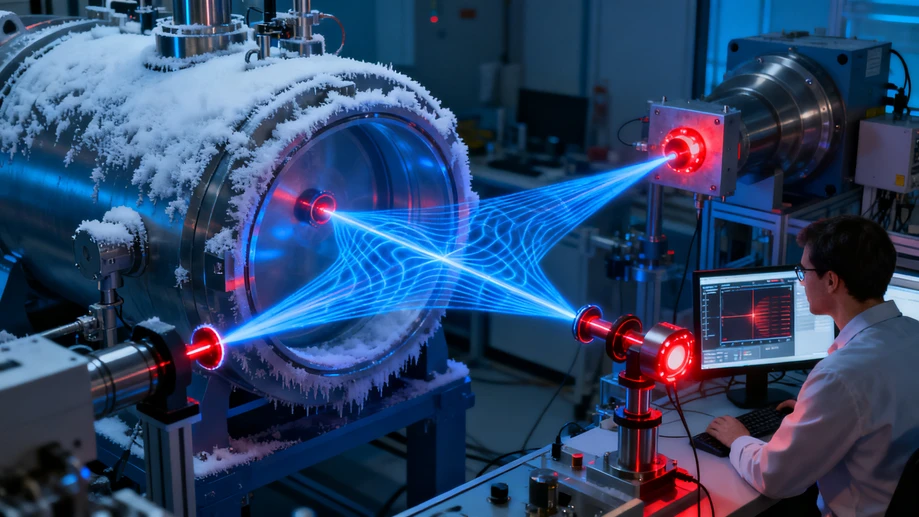
Experimental validation of entanglement began in earnest in the 1970s and has since been confirmed through numerous sophisticated tests. One landmark experiment by Alain Aspect in 1982 used polarized photons to demonstrate violations of Bell's inequalities, effectively proving that entanglement is a genuine quantum effect and not an artifact of hidden variables. Modern experiments employ advanced technologies like quantum optics setups, where lasers generate entangled photon pairs, and detectors measure their correlations across vast distances. For example, in 2017, Chinese scientists conducted a satellite-based experiment, entangling photons over 1,200 kilometers, reinforcing that entanglement persists even in space. These findings consistently show that entangled particles exhibit correlations with near-perfect accuracy, far exceeding what classical physics allows. The precision of such experiments relies on isolating particles in controlled environments, such as vacuum chambers, to minimize decoherence—the loss of quantum properties due to environmental interactions.
Beyond theoretical intrigue, quantum entanglement underpins revolutionary applications in technology, particularly in quantum computing and cryptography. In quantum computing, entangled qubits (quantum bits) enable parallel processing capabilities that vastly outperform classical computers. For instance, a quantum computer can solve complex problems like factoring large numbers or simulating molecular structures in seconds, tasks that would take conventional supercomputers millennia. Entanglement allows qubits to exist in superpositions—multiple states simultaneously—and when entangled, they process information collectively. This leads to exponential speed-ups, as seen in algorithms like Shor's algorithm for encryption breaking. Similarly, quantum cryptography leverages entanglement for ultra-secure communication; in quantum key distribution (QKD), any attempt to eavesdrop on an entangled signal disrupts the correlation, immediately alerting users to potential breaches. These applications are advancing rapidly, with prototypes already deployed in secure networks and research labs worldwide.
The implications of entanglement extend far beyond technology, challenging fundamental philosophical concepts about reality and locality. It questions the principle of local realism—the idea that objects have definite properties independent of observation and that influences propagate at finite speeds. Entanglement suggests that at a quantum level, reality is non-local and probabilistic, with properties not fixed until measured. This has sparked debates in interpretations of quantum mechanics, such as the Copenhagen interpretation, which emphasizes the role of the observer, or the many-worlds theory, proposing parallel universes. Moreover, entanglement hints at a deeper interconnectedness in the universe, potentially linking to theories like quantum gravity or the holographic principle. As research progresses, with experiments probing entanglement in macroscopic objects or biological systems, it continues to reshape our understanding, highlighting that the quantum world operates by rules that defy everyday intuition and open new frontiers in science.