Microbe Munchers: When Bacteria Flip the Switch
Tiny organisms could soon charge your phone while cleaning our rivers.
Imagine a future where wastewater treatment plants aren't just pollution scrubbers, but bustling miniature power stations. Sounds like science fiction? Welcome to the fascinating world of Microbial Fuel Cells (MFCs), a technology where nature's tiniest cleaners double as microscopic electricians.
The core idea is delightfully simple, yet mind-bogglingly complex under the hood. Certain types of bacteria, the kind that naturally thrive in mucky environments like soil, sediments, or even your gut, possess a nifty biological trick. As they munch on organic matter – essentially their food, like sugars, fats, or the pollutants found in wastewater – they break it down. Crucially, during this metabolic feast, these bacteria naturally generate electrons as a byproduct. Think of them as tiny biological motors spinning off electrical sparks while they digest.
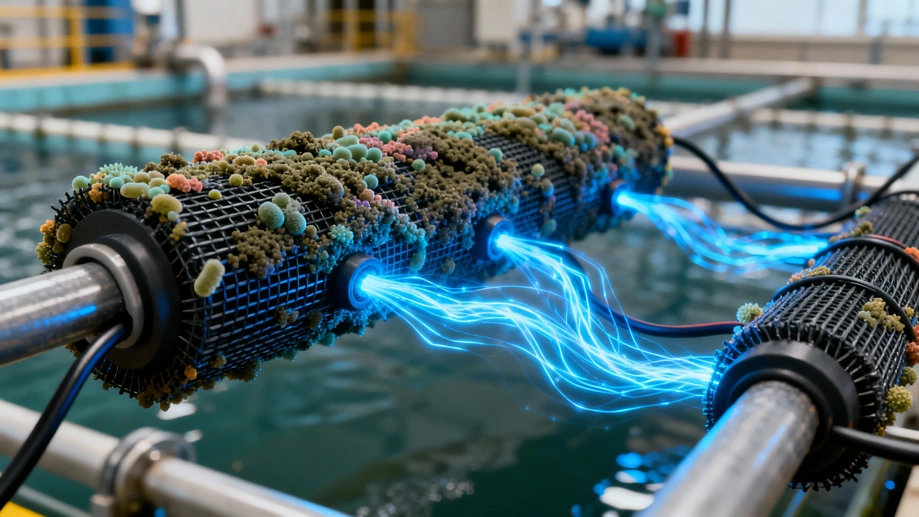
Here's where the magic happens. In a traditional compost heap, these electrons just dissipate harmlessly. But inside a cleverly designed MFC, engineers trap those free-roaming electrons. They coax the bacteria to cling to a special electrode, called the anode (the negative terminal), essentially turning it into a microbial dining table. As the bacteria dine on waste and produce electrons, those electrons are siphoned off through an external electrical circuit. This flow of electrons is electricity! Finally, the electrons complete their journey by reaching another electrode, the cathode (the positive terminal), often aided by oxygen in the air or another chemical.
It gets even more impressive. The fuel for these bio-batteries isn't coal or gas; it's the very pollutants we need to get rid of. Organic contaminants in sewage, agricultural runoff, or even the leftovers from food processing become the primary energy source. The bacteria not only generate electricity but simultaneously break down and clean the waste, mimicking natural purification processes but turbocharged within the confines of the fuel cell.
Now, let's be honest. MFCs aren't about to dethrone massive solar farms or colossal wind turbines in terms of raw power output. Currently, they produce a relatively modest amount of electricity – enough to potentially power small sensors, trickle-charge devices, or help run parts of the very treatment facilities they're deployed in. Scaling them up efficiently and cost-effectively to generate utility-scale power remains a significant engineering hurdle. Keeping the hungry microbial communities happy, optimized, and densely populated on the electrodes is an ongoing area of intense research.
However, the appeal lies far beyond sheer wattage. Their niche is the elegant marriage of waste treatment and energy capture. Particularly in remote areas lacking stable grid connections or conventional treatment infrastructure, small-scale MFCs offer a tantalizing proposition: clean water and localised power in one resilient package. Think villages using local wastewater to power essential sensors or lights.
Researchers aren't just resting on the neatness of the concept; they're constantly tweaking the recipe. Advancements focus on identifying more voracious and electrically-efficient bacterial strains. A major push is on developing cheaper, more porous electrode materials – often exploring novel carbon-based structures – to provide the bacteria with vast apartment complexes to live and work in. Optimizing the internal architecture for smoother electron flow and improving the chemical reactions at the cathode are also key frontiers.
The buzz around MFCs is tangible. Pilot projects are popping up globally – from embedding them in the sediment of restored wetlands to integrate power generation with ecosystem health, to trials within actual municipal wastewater facilities where they chip in on energy demands. The hope isn't necessarily to meet all power needs, but to drastically slash the substantial energy footprint of waste treatment. One day, perhaps, seeing an MFC humbly cleaning our water while quietly charging a backup battery might be as commonplace as seeing solar panels on a roof.
Microbial fuel cells offer a potent glimpse into a possible future: a closed-loop system where waste isn't just managed, but actively transformed into a resource. They prove that sometimes, the most potent solutions aren't about brute force, but about harnessing the ingenious, evolved wisdom of the microscopic world beneath our feet.