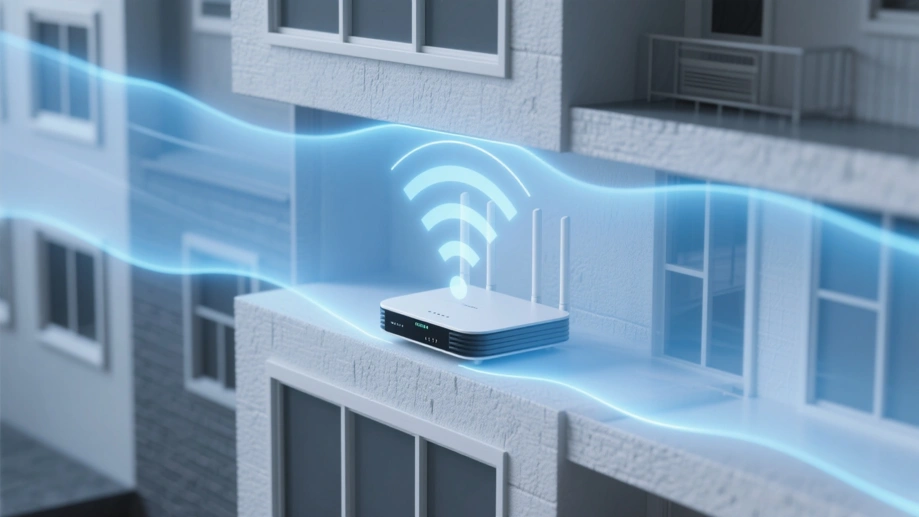
Ghost Waves: When Your Wi-Fi Walks Through Walls
The silent magic of radio signals bending around your home
Ever paused to wonder how your video call stays crisp while you pace from the living room to the kitchen? That invisible messenger dodging furniture and concrete deserves a spotlight. Radio waves, the tireless carriers of Wi-Fi signals, operate far below visible light on the electromagnetic spectrum – typically between 2.4 GHz and 5 GHz frequencies. These waves are masters of penetration, slipping through drywall like sunlight through gauze. Their wavelength, ranging from about 12 centimeters to 5 centimeters, is perfectly sized to navigate the molecular gaps in common building materials. It’s not true teleportation, but rather a sophisticated game of electromagnetic hide-and-seek where waves squeeze through microscopic openings humans can’t even see.
Materials play a fascinating game of pick-and-choose with these signals. Drywall and wood act like welcoming hosts, allowing most waves to pass through with minimal resistance. Water molecules, however, throw a stubborn party trick. They absorb tremendous amounts of energy at 2.4 GHz, heating up quickly – which is exactly how microwave ovens work! Concrete and metal behave like digital bouncers; their dense structures reflect radio waves almost completely. Ever notice weak spots near elevators or load-bearing pillars? That’s reinforced steel rebuffing your data streams. Mirrors and large appliances follow suit, creating frustrating “dead zones” where signals bounce away rather than push through.
Refraction adds another layer to this physics ballet. When a Wi-Fi signal hits materials at an angle, it doesn’t just stop or pass straight through. Like light bending when it enters water, radio waves slightly change direction upon encountering different densities. This bending effect helps signals navigate around corners of thick walls or bookcases. Diffraction further softens the journey. Imagine waves gently wrapping around the sharp edge of a doorway like water flowing around a rock, spreading into shadowed areas beyond where direct signals couldn’t reach. This subtle spreading explains why signal strength fades gradually rather than dropping instantly behind barriers.
Signal loss, measured in decibels (dB), tells the story of a wave’s struggle. Every wall slice takes its toll. Standard drywall might cause a 3 dB loss, cutting signal strength in half. Concrete walls can impose a harsh 10-15 dB penalty, reducing intensity to a fraction. Double that wall thickness, and losses compound exponentially. This explains why routers often struggle with multi-story homes; floors stacked with plumbing, wiring, and dense materials cascade into a signal graveyard unless strategically bypassed.
Antenna placement becomes critical against these obstacles. Router antennas transmit signals not in perfect spheres, but in flattened donut shapes perpendicular to the antenna rod. Positioning antennas vertically maximizes horizontal coverage across rooms. Placing the router centrally avoids making signals traverse unnecessary walls. Elevation matters too – signals travel slightly better downward than upward. Keeping routers off cluttered floors and away from metal shelves minimizes interference.
Advancements continually reshape this hidden landscape. Modern Wi-Fi 6 and upcoming Wi-Fi 7 standards use “beamforming” technology where routers identify device locations and focus signal energy like a spotlight instead of broadcasting indiscriminately. Mesh networks deploy satellite units to create overlapping coverage blankets, ensuring strong signals penetrate deep into challenging spaces. Even as we stream higher resolutions and add more smart devices, the quiet persistence of radio waves bending through your walls remains one of technology’s most reliable everyday feats.