What Happens Inside a Black Hole?
Exploring the enigmatic core of these cosmic phenomena and the physics that govern their mysterious interiors.
Black holes represent one of the most extreme and fascinating objects in the universe, formed from the gravitational collapse of massive stars. When a star exhausts its nuclear fuel, it undergoes a supernova explosion, leaving behind a core so dense that its gravity prevents anything, including light, from escaping. This creates a region in space-time where the gravitational pull is infinitely strong, defined by an outer boundary known as the event horizon. Beyond this point, the laws of physics as we know them begin to break down, leading to intense scientific inquiry. The study of black holes not only challenges our understanding of general relativity but also offers insights into the fundamental nature of gravity, space, and time. Researchers use advanced telescopes and theoretical models to probe these invisible entities, revealing clues about their formation and role in galaxy evolution.
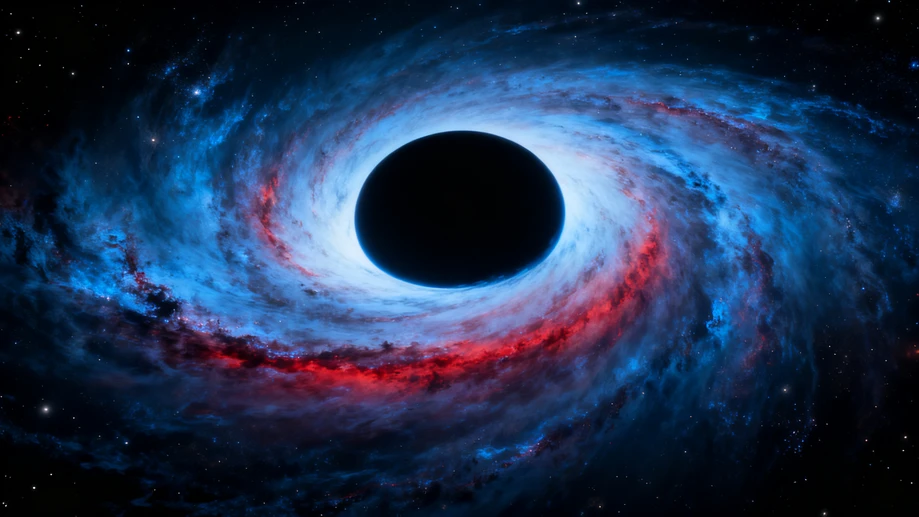
At the heart of a black hole lies the event horizon, a spherical boundary that marks the point of no return. Once an object crosses this threshold, it cannot escape the gravitational pull, and its fate is sealed to be drawn inexorably toward the central singularity. The event horizon is not a physical surface but a mathematical construct where the escape velocity equals the speed of light. This concept, derived from Einstein's theory of general relativity, implies that time and space are warped to such an extent that light rays bend back on themselves. Observations from instruments like the Event Horizon Telescope have captured images of event horizons, such as that of the supermassive black hole in the galaxy M87, providing empirical evidence for these theoretical predictions. These images show a dark shadow surrounded by a bright ring of light, representing the photon sphere where light orbits the black hole before being consumed.
Venturing inside the event horizon, the gravitational forces intensify dramatically, leading to the singularity at the center. A singularity is a point of infinite density and zero volume, where the curvature of space-time becomes infinite, and the known laws of physics cease to apply. In this region, matter is compressed beyond comprehension, and quantum gravitational effects dominate, though current theories like general relativity cannot fully describe it. The journey toward the singularity involves spaghettification, a process where tidal forces stretch objects into long, thin strands due to the extreme gravity gradient. For an observer falling in, time dilation effects would cause time to slow relative to an outside viewer, making the descent appear instantaneous from within but prolonged from afar. This paradox highlights the need for a unified theory of quantum gravity to reconcile general relativity with quantum mechanics.
Surrounding many black holes is an accretion disk, a swirling ring of superheated gas, dust, and stellar debris that orbits at relativistic speeds. As material spirals inward, friction and gravitational energy heat it to millions of degrees, emitting intense radiation across the electromagnetic spectrum, from X-rays to radio waves. These disks are observable phenomena that allow astronomers to detect and study black holes indirectly. In active galactic nuclei, such disks can power quasars, some of the brightest objects in the universe, by converting gravitational potential energy into luminous output. Additionally, magnetic fields within the disk can launch powerful jets of particles perpendicular to the plane, traveling at near-light speeds. These jets influence star formation and galaxy dynamics, serving as cosmic engines that redistribute matter and energy throughout the cosmos.
Quantum effects introduce another layer of complexity through Hawking radiation, a theoretical prediction by Stephen Hawking that black holes can emit particles and gradually lose mass over time. Near the event horizon, virtual particle-antiparticle pairs are created from quantum fluctuations; if one particle falls in while the other escapes, it results in net radiation that carries energy away from the black hole. This process causes black holes to evaporate, with smaller holes evaporating faster than larger ones. For stellar-mass black holes, this evaporation is negligible over cosmic timescales, but primordial black holes formed in the early universe could be detectable through their final explosive bursts. Hawking radiation bridges quantum mechanics and gravity, suggesting that black holes have entropy and temperature, properties typically associated with thermodynamic systems.
The broader implications of black holes extend to cosmology and the fate of the universe. Supermassive black holes, found at the centers of most galaxies including our Milky Way, play a crucial role in galactic evolution by regulating star formation through feedback mechanisms. Gravitational waves detected by observatories like LIGO and Virgo provide evidence of black hole mergers, offering a new window into testing relativity and probing the early universe. Future missions, such as the James Webb Space Telescope, aim to observe black holes in greater detail, potentially revealing insights into dark matter and the expansion of the cosmos. Understanding these enigmatic objects not only advances fundamental physics but also inspires technological innovations in imaging and data analysis.