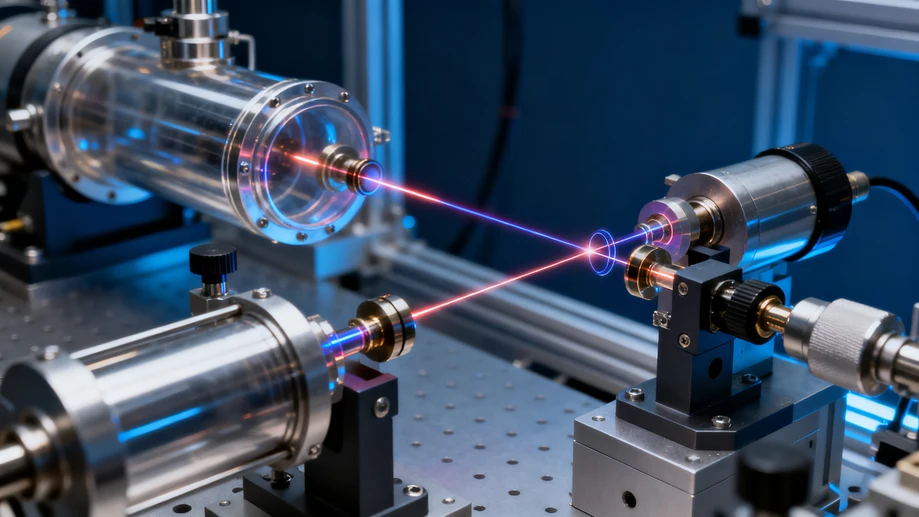
The Ghostly Gossip of Quantum Entanglement
Unraveling how tiny particles chat across cosmic distances without any wires or signals involved.
Ever wonder if objects could whisper secrets to each other from miles apart as if they're sharing one soul? That's the strange tale of quantum entanglement, a phenomenon from the subatomic world that makes distant particles act like inseparable twins. Imagine two coins flipped together—no matter how far they travel, if one lands heads-up, the other instantly shows tails without any delay. This isn't science fiction; it's a real, mind-bending quirk of nature that scientists explore daily. Intriguingly, it defies our everyday logic where actions take time to relay, sparking a revolution in how we understand the universe. Quantum entanglement shows us that at the tiniest scales, reality doesn't play by the rules we're used to.
At its heart, entanglement occurs when pairs of particles—like electrons or photons—get so intertwined during creation that they share an invisible thread linking their properties. For instance, if one particle spins clockwise, its entangled partner must spin counterclockwise immediately, even if separated by light-years. This happens spontaneously during particle interactions, such as when atoms collide in a vacuum or light splits in crystal experiments. No wires, no messages zipping between them; it's as if they're part of a single, connected system. Such behavior stems from the probabilistic laws of quantum mechanics, where properties like spin or position aren't fixed until observed. Consequently, when one is measured, the other snaps into place instantly, revealing how nature operates on a whimsical dance of probability rather than solid cause-and-effect.
Now, you might think this sounds like magic, but the implications are grounded in rigorous science with practical twists. Instead of dismissing it as ethereal mumbo-jumbo, modern research shows how entanglement powers emerging technologies like quantum computing. In these systems, entangled particles act as bits that process data simultaneously, potentially solving complex problems—say, cracking encryption codes or simulating molecules—in mere seconds that would take supercomputers centuries. Moreover, quantum encryption leverages this spooky link to create unbreakable keys; any attempt to eavesdrop disrupts the entanglement, instantly alerting security. This shift from theory to tech isn't just futuristic dreaming—it's happening in labs worldwide, where devices like quantum sensors detect minute changes in fields or temperatures with eerie precision.
As we embrace these advances, the question isn't about creating sci-fi gadgets but about the ethical and societal impacts. Consider the environmental side: Quantum technologies could slash energy consumption for data centers by optimizing computations, reducing carbon footprints. Similarly, in healthcare, entangled particles might enhance imaging devices for earlier disease detection without invasive probes. However, the very strangeness that makes this useful also poses risks, such as vulnerabilities in communication networks if entanglement is hacked. Thus, ongoing studies focus on stabilizing these systems for real-world use, ensuring they remain reliable and scalable before mass adoption.
Ultimately, quantum entanglement reminds us that the universe holds endless wonders at the microscopic level, challenging human intuition. From powering next-gen innovations to redefining privacy in the digital age, this ghostly bond teaches humility about nature's mysteries. It's not about predicting a distant utopia; it's a tangible step toward harnessing the bizarre for human progress, proving that sometimes, the weirdest phenomena are the most enlightening.