Quantum Entanglement is Real: Here's How It Defies Common Sense
The phenomenon that Einstein famously called "spooky action at a distance" is not only experimentally verified but forms the cornerstone of emerging quantum technologies.
The fundamental laws governing the microscopic world, quantum mechanics, contain features that starkly defy our everyday intuition rooted in classical physics. Among the most profound and counter-intuitive is quantum entanglement. This phenomenon describes a deeply intertwined connection between two or more particles, such that the quantum state of one particle is intrinsically linked to the state of the other(s), regardless of the physical distance separating them.
The concept was brought to sharp focus by a famous 1935 paper by Albert Einstein, Boris Podolsky, and Nathan Rosen (the EPR paradox paper). They used entanglement as an argument to suggest quantum mechanics was incomplete, highlighting its seeming violation of "local realism". Local realism posits that physical reality exists objectively independent of observation (realism) and that influences cannot propagate faster than light (locality). Entanglement appeared to violate locality: measuring the property (e.g., spin or polarization) of one entangled particle instantaneously determines the state of its partner, even if they are light-years apart. Einstein derided this seemingly instantaneous influence as "spooky action at a distance," implying quantum mechanics must be missing some hidden variables that predetermine the particle states locally.
For decades, entanglement remained largely a theoretical curiosity and a point of philosophical debate. The critical breakthrough came in 1964 when physicist John S. Bell formulated his famous theorem. Bell derived mathematical inequalities (Bell inequalities) that differentiate between quantum mechanics and any theory reliant solely on local hidden variables. If the predictions of quantum mechanics, particularly concerning entangled particles, were correct, these inequalities would be violated under specific experimental conditions.
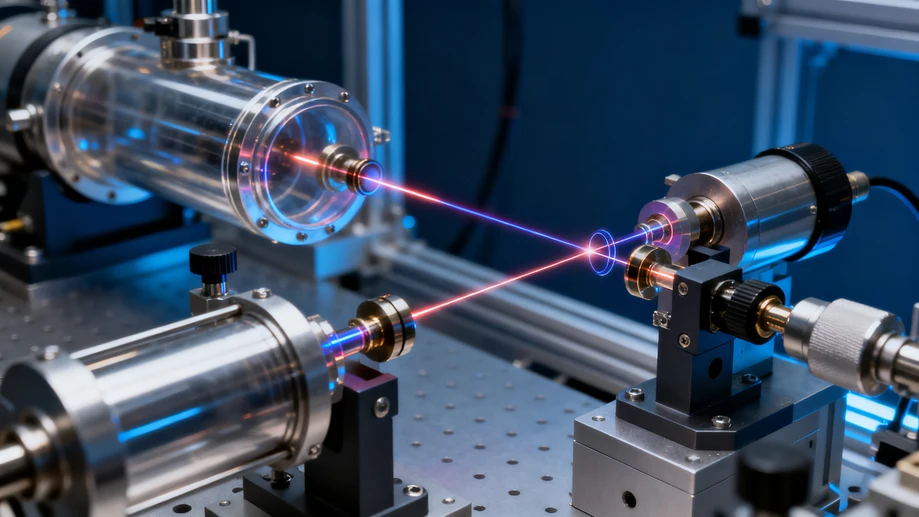
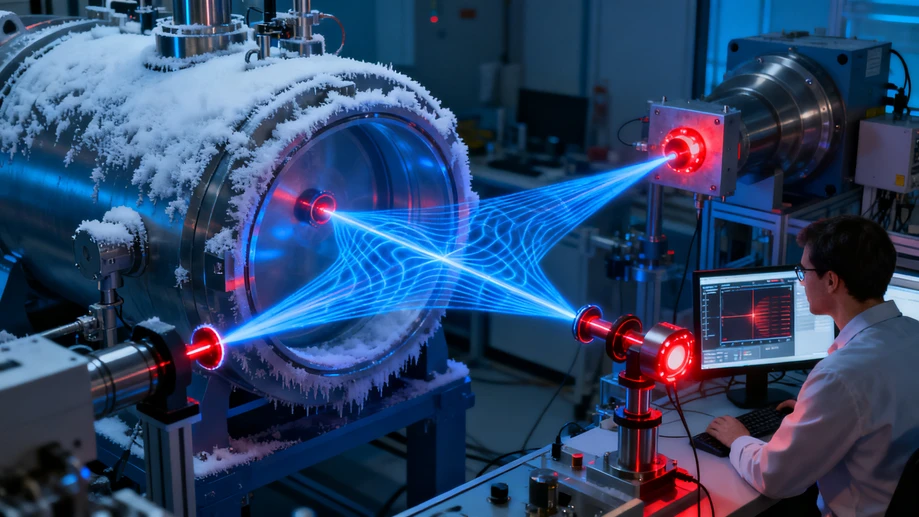
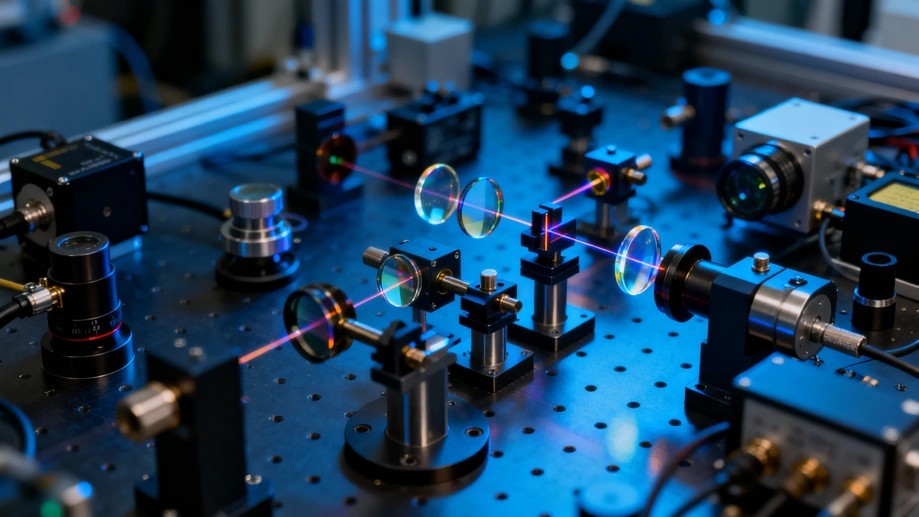
Beginning in the 1970s and 1980s, most famously in experiments by Alain Aspect and colleagues, researchers began testing Bell's inequalities. These experiments used entangled photon pairs and meticulously designed setups to close potential loopholes. The results were unequivocal: the predictions of quantum mechanics were confirmed, and Bell inequalities were consistently violated. The experimental verdict was clear – no local hidden variable theory could reproduce all the experimental data. Quantum entanglement is a genuine, non-local phenomenon inherent to the fabric of reality. Instantaneous correlation, though devoid of *useful* information transfer faster than light, demonstrably exists.
Understanding entanglement requires acknowledging that before measurement, the entangled particles do not possess definite individual states independently. Instead, they exist within a single, shared quantum superposition described by a unified wavefunction. This global state defines the *correlations* between the particles. Measurement on one particle forces the entire entangled system to "collapse" into a definite state, thereby immediately defining the state of the other particle(s), irrespective of distance. The key is that the correlation is established when the particles become entangled, not when the measurement occurs. No energy or classical information travels faster than light during the measurement event itself; the "spookiness" arises from the inherent non-separability of the quantum state.
Far from being just a theoretical oddity, quantum entanglement is the essential resource powering the rapidly evolving field of quantum information science. Quantum computers harness entangled quantum bits (qubits) to perform computations intractable for classical machines, exploiting superposition and entanglement to explore vast solution spaces simultaneously. Quantum communication protocols, like Quantum Key Distribution (QKD), use entanglement to create inherently secure cryptographic keys. Any attempt by an eavesdropper to intercept the quantum channel inevitably disturbs the delicate entangled state, revealing their presence. Entanglement also enables protocols such as quantum teleportation, where the exact quantum state of one particle can be transferred to another distant particle (though crucially, not faster than light, as it requires transmitting classical information).
Ongoing research delves into fascinating extensions and implications of entanglement. How does entanglement behave in macroscopic systems? (Experiments entangling larger molecules and tiny mechanical oscillators are making progress.) Can entanglement persist over intercontinental distances or even between Earth and satellites? (Successful experiments have been performed.) What is the role of entanglement in complex quantum many-body systems, potentially even playing a role in exotic states of matter? Furthermore, the process of decoherence, where environmental interactions destroy quantum coherence and entanglement, presents a major challenge for practical quantum technologies, driving intense research into quantum error correction.
The experimental validation of quantum entanglement stands as a testament to the profoundly non-classical nature of reality at its most fundamental level. It compels us to abandon comfortable classical intuitions about locality and separability. While its implications continue to challenge our understanding and raise deep philosophical questions about the nature of reality, entanglement is simultaneously being harnessed as a powerful technological tool. It serves as the bedrock upon which the second quantum revolution, promising transformative computational power and communication security, is being built. Its reality is undeniable, its non-locality experimentally proven, and its potential technological impact immense, forever altering our comprehension of the quantum universe.