Quantum Entanglement: Nature’s Invisible Superhighway
When Particles Dance in Perfect Sync Across the Universe
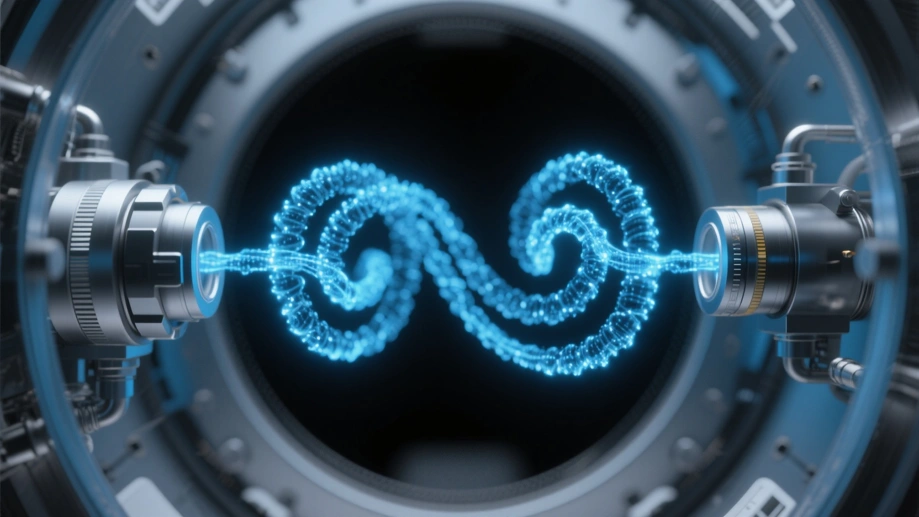
Imagine tossing two coins into opposite ends of the galaxy. You check one coin – it lands heads up. Instantly, without any signal or delay, you know the other coin shows tails. This isn’t science fiction; it’s the bizarre reality of quantum entanglement, a phenomenon Albert Einstein famously called "spooky action at a distance." At its core, entanglement links particles so intimately that measuring one instantly defines the state of its partner, regardless of the miles or light-years between them. This connection defies classical physics, where information can’t travel faster than light. Yet here, nature has built an invisible superhighway where particles communicate in perfect, silent harmony.
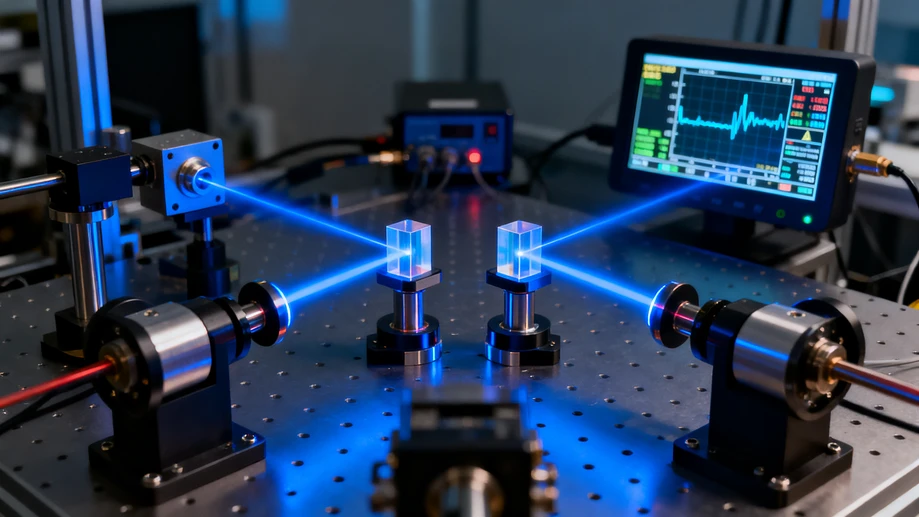
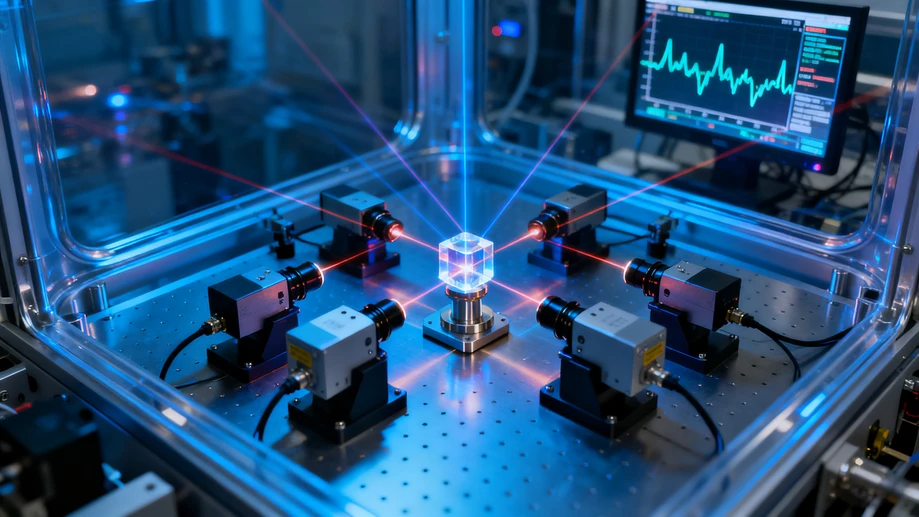
How does this cosmic choreography work? It starts when subatomic particles like photons or electrons interact and become "entangled." Their properties—spin, polarization, or momentum—merge into a single shared state. Crucially, these properties aren’t predetermined. Before measurement, they exist in a fuzzy cloud of possibilities. But once you observe Particle A, its wave function collapses, and Particle B snaps into a complementary state faster than light could bridge the gap. Experiments have confirmed this across distances exceeding 1,200 kilometers. Scientists sent entangled photons between mountaintops and satellites, observing synchronized changes with near-perfect correlation. The results were unambiguous: this connection is real, immediate, and unaffected by physical barriers.
What powers this eerie synchronization? The answer lies in quantum superposition and non-locality. Superposition allows particles to exist in multiple states simultaneously (like a coin spinning mid-air). When entangled particles separate, their combined quantum state stretches across space. Measuring one particle doesn’t "send a signal" to the other; instead, it reveals a truth about the shared system that was always true. This non-locality—where particles ignore spatial separation—challenges our everyday intuition. It’s as if the universe maintains a hidden ledger, updating entries instantaneously. Despite decades of research, the exact mechanism remains elusive, deepening entanglement’s mystique while fueling scientific curiosity.
The magic of entanglement isn’t confined to theoretical wonders—it’s paving roads to revolutionary technology. Quantum cryptography, for example, leverages entanglement to create unhackable communication. Any eavesdropping attempt disrupts the particles’ delicate state, alerting users immediately. Meanwhile, quantum computing harnesses entangled "qubits" to perform calculations at speeds inconceivable to classical computers. These qubits process complex scenarios—like simulating chemical reactions or optimizing global logistics—in parallel, thanks to their linked states. Current prototypes already outperform supercomputers in niche tasks, hinting at a future where weather prediction or drug discovery transforms from years to minutes.
Beyond tech applications, entanglement offers glimpses into nature’s foundational blueprints. Some theories propose it underpins gravity itself, acting as cosmic "glue" woven into spacetime’s fabric. Others explore entanglement’s role in photosynthesis, where plants efficiently transfer energy using quantum coherence. Even black holes may use entanglement to preserve information swallowed by their event horizons. These ideas bridge quantum mechanics with cosmology, suggesting a unified cosmic language far stranger than we imagined. While mysteries linger, one truth shines clear: entanglement reveals a universe deeply interconnected, where particles whisper secrets across the void, knitting reality into a seamless tapestry.